
A campaign can look weak in-platform and still be creating profitable customers. Another can claim a healthy return while harvesting demand generated by creative, search, or email somewhere else. That is the operating problem this marketing attribution guide is built to solve: making budget decisions with enough context to scale winners without rewarding the wrong activity.
For paid growth teams, attribution is not a reporting exercise. It is the decision system behind creative testing, channel allocation, campaign structure, and forecasts. If the system is slow, fragmented, or overly certain, media buyers optimize toward noise. That is how spend drifts into campaigns that look efficient on a dashboard but fail to grow the business.
What Marketing Attribution Should Actually Do
Marketing attribution assigns credit for a conversion across the touchpoints that influenced it. In practice, its job is simpler than most attribution software demos suggest: help your team decide where the next dollar should go.
A useful system should answer a few operational questions. Which channels create incremental demand? Which creative concepts attract customers who convert and retain? Where are we paying to capture people who would have converted anyway? And how quickly can we detect a real change before wasted spend compounds?
No single attribution model answers all of those questions perfectly. Platform reporting has speed and granularity. Analytics tools offer a more consistent cross-channel view. Post-purchase surveys reveal self-reported influence. Incrementality testing gets closer to causation. Each source has blind spots, which is why experienced teams use them together rather than letting one dashboard dictate every decision.
Why Attribution Gets Harder as You Scale
At lower spend, teams can often make reasonable calls using platform-reported conversions and a basic analytics setup. At scale, the gaps become expensive. Meta may receive credit for a conversion that Google Search helped close. TikTok may introduce a prospect who later returns through branded search. Taboola or native placements may generate demand that shows up as direct traffic days later.
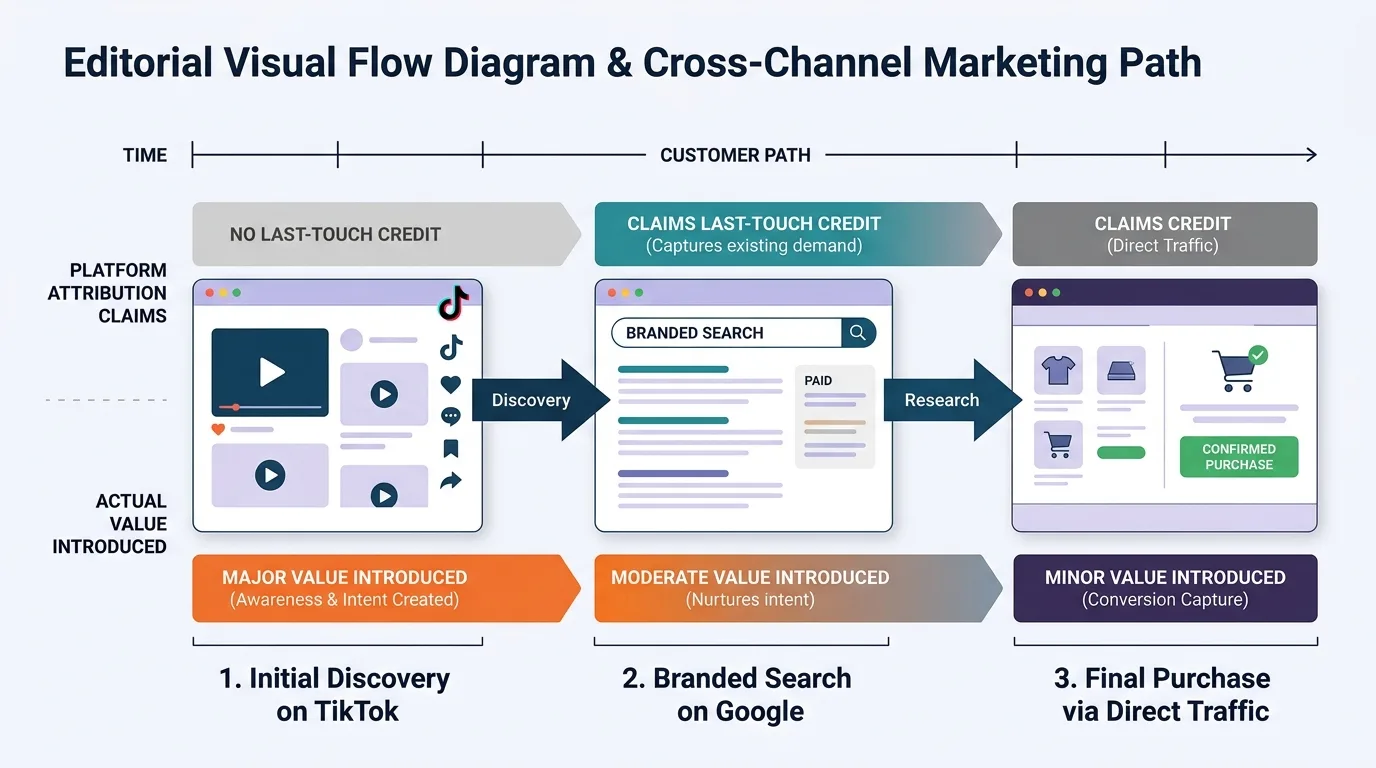
Privacy restrictions, cookie loss, cross-device behavior, long buying cycles, and incomplete server-side tracking make the picture less clean. That does not mean attribution is broken. It means false precision is dangerous.
The bigger issue is operational. When creative, media buying, analytics, and finance all use different definitions of a conversion, nobody can move quickly with confidence. One team sees a winner. Another sees deteriorating margin. A third cannot reconcile revenue at all. The result is slower testing, more meetings, and decisions made on the loudest data source.
Start With the Business Outcome, Not the Model
Before choosing attribution logic, define the outcome that matters commercially. For ecommerce, that may be contribution margin after returns, not just first-purchase revenue. For lead generation, it may be qualified leads, funded accounts, or closed revenue rather than form fills. For subscription businesses, it may be trial-to-paid rate and early retention. For apps, installs matter, but downstream activation and payer quality matter more.
This step sounds obvious, yet it is where many reporting systems fail. A channel optimized to cheap leads will produce cheap leads. If those leads do not become customers, the acquisition team has not found efficiency. It has shifted the cost downstream.
Your primary optimization event should be close enough to revenue to protect quality and frequent enough to support campaign learning. There is a trade-off. Optimizing toward a purchase or qualified sale usually improves quality but may reduce signal volume. Optimizing toward an earlier event creates more data but can invite low-intent volume. The right choice depends on conversion volume, sales cycle length, and how reliably early behavior predicts value.
The Marketing Attribution Guide to Core Models
Attribution models are rules for assigning conversion credit. They are not truth. Their value depends on the decision they support.
Last-click attribution gives all credit to the final known touchpoint. It is easy to understand and useful for evaluating bottom-of-funnel capture, especially non-brand search and affiliate activity. Its weakness is predictable: it undervalues the channels and creative that created awareness before the final click.
First-click attribution gives credit to the initial interaction. This can help identify prospecting channels that introduce new customers. It can also overvalue a touchpoint that merely happened first and had little influence on the final decision.
Multi-touch attribution distributes credit across interactions, either evenly, based on position, or through an algorithmic approach. It is useful when buyers regularly interact with several channels before converting. But it should not become a black box. If your team cannot explain why a model changed credit allocation, it is hard to act on the output.
Data-driven attribution uses observed conversion paths to estimate the relative contribution of touchpoints. It can be more adaptive than fixed rules, particularly with sufficient volume. It still relies on the data it can observe, which means missing impressions, walled gardens, and offline activity can distort the result.
Incrementality measurement asks the hardest and most valuable question: would this conversion have happened without the marketing exposure? Holdouts, geo tests, conversion lift studies, and budget experiments are closer to causal measurement than click-path models. They require planning and discipline, but they are often the best way to challenge channels that appear efficient because they harvest existing demand.
For most performance organizations, the answer is a measurement stack rather than one chosen model: platform data for daily optimization, analytics for cross-channel trends, backend revenue data for quality, and controlled tests for major budget decisions.
Comparison of Core Attribution Models
| Model | Best Use Case | Major Limitations | Setup Difficulty |
|---|---|---|---|
| Last-Click | Evaluating bottom-of-funnel conversion capture and affiliate activity. | Systematically undervalues early-stage prospecting and brand discovery. | Low |
| First-Click | Identifying top-of-funnel channels initiating discovery. | Overvalues incidental initial clicks that did not drive conversion intent. | Low |
| Multi-Touch | Analyzing complex, multi-touch digital customer journeys. | Risk of becoming an opaque, non-actionable algorithmic black box. | Medium to High |
| Data-Driven | Dynamic credit assignment in high-volume, clean environments. | Vulnerable to data gaps from cookie loss and walled gardens. | High |
| Incrementality | Causal measurement, budget validation, and identifying waste. | Requires operational discipline, lift tests, and structured holdouts. | High |
Build a Measurement Stack Your Team Can Operate
Start by making event definitions consistent. A purchase, lead, subscription start, or qualified conversion should mean the same thing in your ad platforms, analytics environment, CRM, and financial reporting. Document the source of truth for revenue, refunds, cancellations, lead quality, and customer status.
Then improve signal capture. Use server-side event tracking where appropriate, pass reliable click identifiers, preserve UTM discipline, and connect conversion data back to ad platforms when possible. Tracking will never be perfect, but basic hygiene prevents avoidable blind spots.
Next, establish reporting layers. Your media team needs a daily view that flags delivery issues, creative fatigue, cost changes, and conversion volume. Leadership needs a weekly or monthly view tied to revenue, margin, customer quality, and blended acquisition efficiency. These reports should complement each other. A campaign-level decision and a company-level investment decision are not the same decision.
Blended metrics are especially useful as a control mechanism. Blended CAC, marketing efficiency ratio, new customer revenue, and contribution margin can expose problems that channel-level attribution hides. They are less diagnostic than platform reports, but they are much harder to game.
Use Attribution to Improve Creative, Not Just Channel Budgets
Creative is often the first touchpoint, even when it gets little formal credit. A video on TikTok, a Meta static ad, or a native advertorial may create the interest that later converts through search or direct traffic. If you judge every asset only by last-click ROAS, you will likely cut the concepts that expand demand.
Instead, evaluate creative at multiple levels. Start with direct response performance: spend, conversion volume, CPA, and revenue. Then look at leading indicators such as hold rate, click-through rate, landing-page engagement, and new-customer mix. Finally, examine whether periods of increased spend behind a concept correspond with lift in branded search, direct conversions, or overall new-customer volume.
This does not mean keeping weak creative alive because it might be assisting somewhere. The standard is still performance. It means giving prospecting creative enough time, volume, and context to prove its role before making a cut.
High testing velocity makes this easier. When teams launch enough distinct angles, formats, hooks, and offers, patterns emerge faster. You can see whether a creative idea works across placements and channels, not just whether one ad set had a good three-day run.
Common Attribution Mistakes That Waste Spend
The first mistake is treating platform reporting as fraudulent or flawless. Both reactions are lazy. Platforms are useful optimization systems with incentives and visibility limits. Use their data, but verify major decisions against backend and blended outcomes.
The second is optimizing only for attributed ROAS while ignoring incrementality. Branded search, retargeting, and bottom-funnel campaigns often look exceptional because they capture high-intent users. That does not make them bad investments. It means their budget ceiling may be lower than the dashboard suggests.
The third is changing too many variables at once. If you launch new creative, alter landing pages, expand audiences, and change bids simultaneously, attribution cannot tell you what caused the result. Structured testing creates clearer signals and protects the learning agenda.
The fourth is waiting for perfect data. Attribution improves through a cadence of measurement, decisions, and validation. A team that can identify a likely winner, scale it with guardrails, and test its incremental impact will outperform a team frozen by dashboard discrepancies.
Make Better Decisions Under Uncertainty
Attribution should create controlled confidence, not false certainty. Set decision thresholds before you scale or cut. Define the minimum spend, conversion volume, time window, and quality signals required for a campaign or creative to earn more budget. Use guardrails such as blended CAC or contribution margin to catch deterioration that in-platform reporting misses.
For larger reallocations, run deliberate tests. Reduce spend in one channel or geography while protecting the rest of the system, then measure the effect on total outcomes. Test creative concepts across more than one placement. Compare customer quality by cohort, not only day-one conversion cost.
The goal is not a perfect map of every customer journey. The goal is an operating system that helps your team move fast, see waste early, and place bigger bets when the evidence is strong enough. When attribution is built for decisions instead of presentations, paid growth becomes easier to control.