
A paid account can look healthy on the surface while leaking budget in places no dashboard headline will show. This ad account audit example follows a common scenario: a growth team spending $180,000 per month across Meta and Google, generating volume, but unable to explain why CPA keeps rising or which ads are actually driving profitable customers.
The point of an audit is not to produce a prettier report. It is to identify the constraints holding back profitable scale, rank them by financial impact, and turn the findings into an execution plan. That requires looking at media buying, creative, tracking, landing pages, and operating cadence as one system.
What a Useful Audit Actually Answers
Most audits stop at surface-level hygiene: duplicate campaigns, broad targeting, missing UTMs, or an outdated naming convention. Those findings matter, but they do not tell a leadership team where to put the next dollar.
A performance audit should answer four operational questions. Where is spend being wasted? What is currently producing incremental, profitable volume? What signal is too weak or delayed to optimize against? And what can the team launch in the next seven to 14 days to improve results?
That standard changes the analysis. A campaign with a high CPA is not automatically a problem if it reaches a high-value customer segment or supports incremental demand. Conversely, a low-CPA campaign may be damaging growth if it only recaptures customers who would have converted anyway. Context matters, especially when attribution windows, sales cycles, and customer value vary by channel.
Ad Account Audit Example: The Starting Point
In this example, the brand is a subscription business spending $110,000 monthly on Meta and $70,000 on Google. Reported blended CAC rose from $74 to $96 over eight weeks. Revenue remained flat despite a 22% increase in spend.
The internal explanation was market fatigue. The audit found something more actionable: creative testing had slowed, budget was concentrated in campaigns with unclear conversion quality, and conversion data was arriving too late to guide daily decisions.
Here is the initial scorecard:
| Area | Finding | Business impact | Priority | |---|---|---|---| | Meta creative | 68% of spend ran through six ads more than 45 days old | CTR fell 31%, increasing CPM pressure and acquisition cost | High | | Meta structure | Prospecting and retargeting audiences overlapped | Budget competed in the same auctions and inflated frequency | High | | Google Search | Brand terms accounted for 41% of reported conversions | Channel efficiency was overstated by demand already created elsewhere | High | | Tracking | Subscription upgrades posted 10 to 14 days after first purchase | Platforms optimized toward lower-value initial buyers | Medium | | Landing pages | Mobile load time exceeded four seconds on the primary offer page | Paid clicks converted below historical benchmarks | Medium |
None of these issues is rare. The value comes from connecting each one to spend, conversion quality, and a specific corrective action.
Step 1: Validate the Numbers Before Judging the Media
An audit should start with measurement because optimization built on unreliable conversion data creates false winners. Compare platform-reported conversions against analytics, CRM or subscription data, and finance-approved revenue where available. The goal is not perfect attribution. It is a decision-grade view of what each platform is likely contributing.
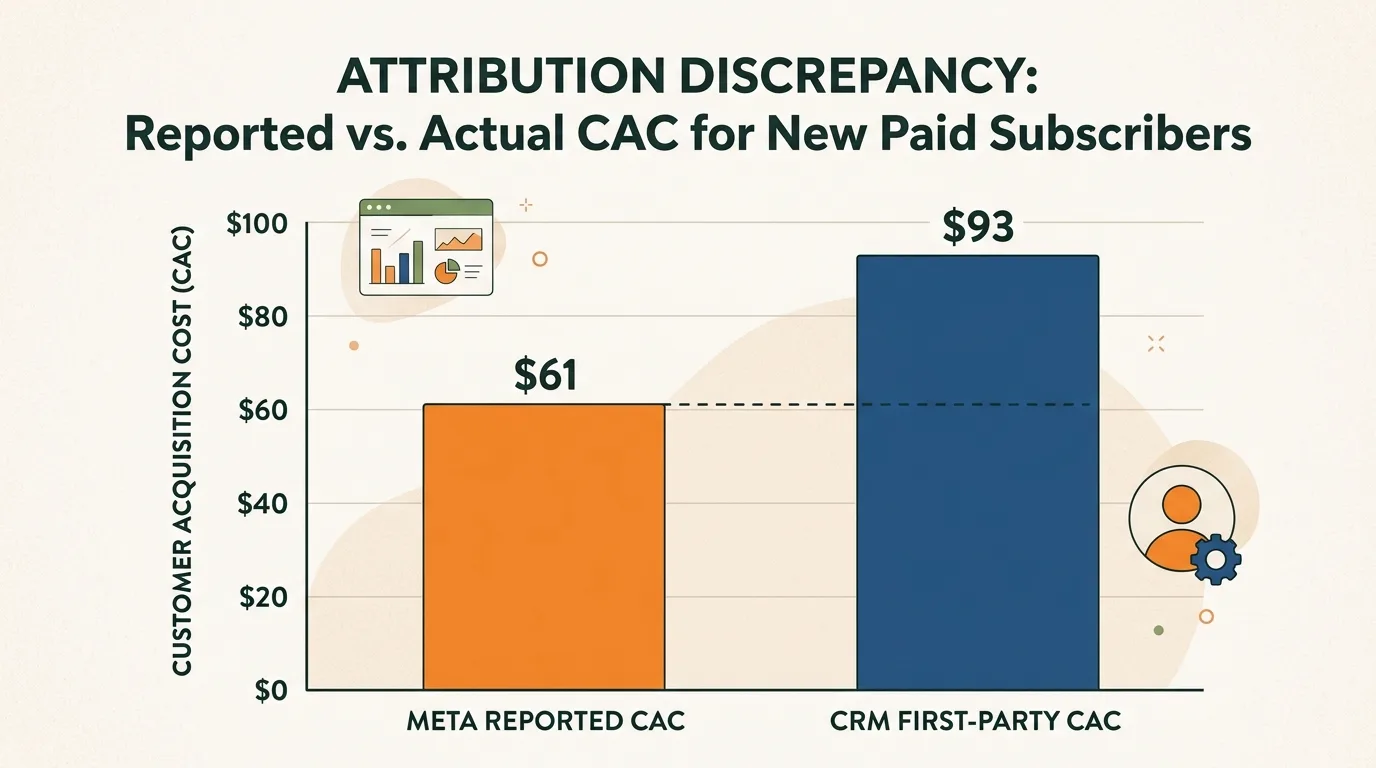
In this account, Meta reported a $61 CAC, while the business’s first-party data showed a $93 CAC for new paid subscribers. The gap did not mean Meta was useless. It meant the platform was receiving credit for view-through and returning-user conversions that the business should not treat as fully incremental acquisition.
The audit also found that the primary conversion event fired before fraud checks and payment failures were resolved. That gave algorithms a larger data set, but a noisier one. The fix was to preserve the early optimization event while sending a later value-based event tied to successful subscription activation. This is a trade-off: waiting for perfect revenue data can starve an account of volume, while optimizing only to early events can scale low-quality conversions. The right setup depends on purchase velocity and available conversion volume.
Step 2: Follow Spend Into Creative, Not Just Campaigns
Creative is often the largest unaddressed variable in a paid account. When teams review campaigns without breaking performance down by concept, hook, format, offer, and audience message, they mistake media structure for the whole problem.
In this case, six long-running ads consumed 68% of Meta spend. They were not terrible ads. They had simply stopped earning their budget. Their click-through rate declined from 1.4% to 0.96%, while frequency climbed above 5.8 for key prospecting segments.
The account had produced only 12 new creative assets in the previous month, and most were minor design variations. There were no new angles addressing the biggest purchase objections: price, commitment length, and results timeline. That is not a creative volume problem alone. It is a testing design problem.
The recommended action was to launch 24 assets over two weeks across four distinct concepts: proof-driven customer outcomes, cost-of-inaction, product demonstration, and objection handling. Each concept would run in multiple static and video executions. This creates enough variation to find a real message-level winner rather than declaring victory because one color treatment slightly improved CTR.
Creative tests need controlled budget and clean readouts. If every new ad launches into a different audience, bid strategy, and placement mix, the team cannot tell what caused the result. Keep the testing environment consistent long enough to evaluate early signals, then move proven assets into scaling campaigns with clear guardrails.
Step 3: Find Structural Waste Without Overbuilding
The Meta account had 19 active campaigns for a relatively simple acquisition objective. Several used overlapping broad, lookalike, and interest audiences. Others existed because previous tests were never closed out. The result was fragmented spend, inconsistent learning, and a campaign tree nobody could manage quickly.
The answer was not to collapse everything into one campaign blindly. Broad consolidation can work well when conversion volume is strong and creative is diverse. It can underperform when a business needs strict control over geography, offers, product lines, or lead quality. The audit recommendation was to reduce the account to three core functions: prospecting scale, structured creative testing, and retargeting.
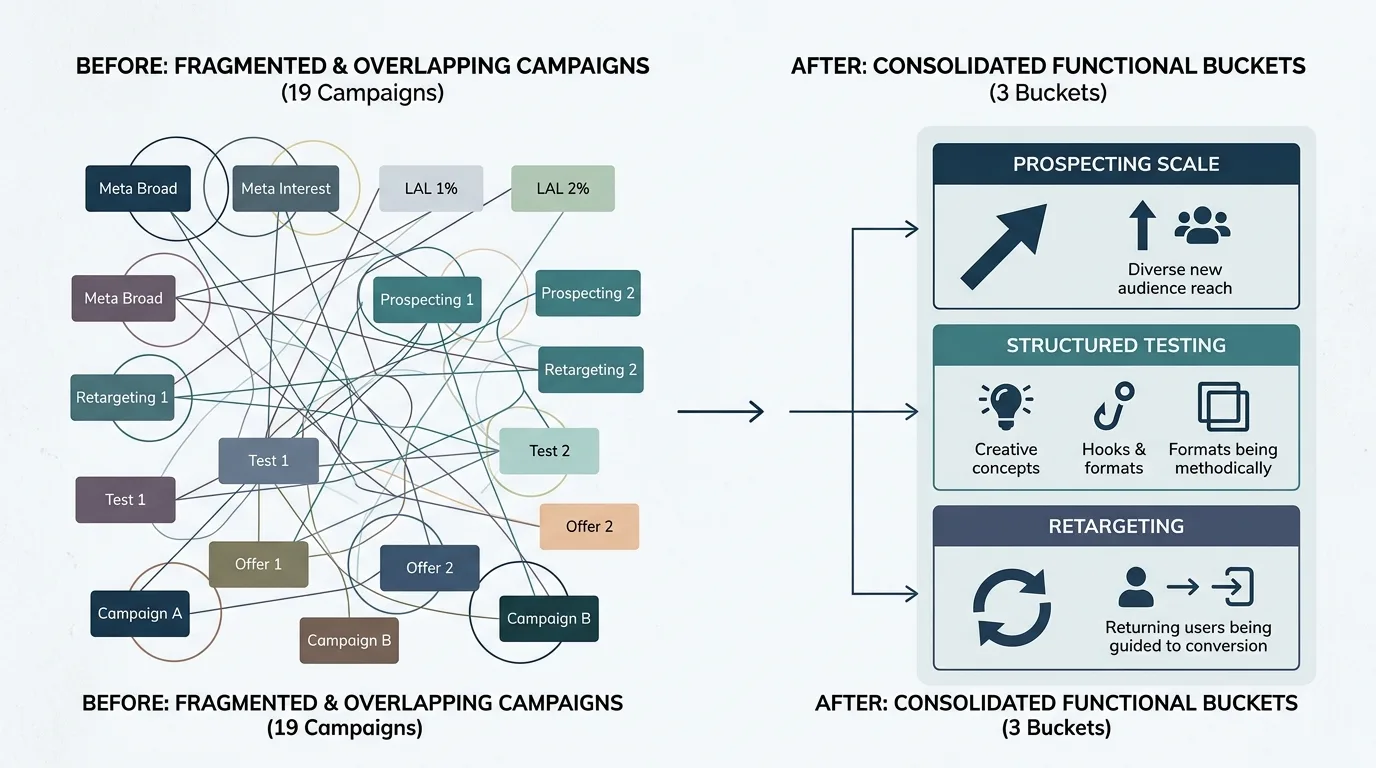
Budgets were then allocated by purpose. Prospecting received the majority of spend and the newest proven ads. The testing campaign received a protected budget that could not be raided whenever daily CPA moved. Retargeting was capped based on reachable audience size rather than allowed to absorb spend because it showed an attractive last-click return.
On Google, the largest structural issue was brand search. It was credited with 41% of channel conversions, but search-term analysis and geo holdout history suggested much of that demand originated from Meta and organic awareness. Separating brand performance from non-brand acquisition gave the team a more honest view of scaling capacity. Brand campaigns remained active because protecting high-intent demand matters, but they were no longer used to justify prospecting expansion.
Step 4: Turn Findings Into a 30-Day Operating Plan
An audit that ends in a slide deck has limited value. The output should be a ranked launch plan with owners, deadlines, expected signal, and a clear decision rule.
For this account, the first week focused on measurement cleanup, campaign consolidation, and pausing ads that had spent more than 1.5 times target CAC without showing a compensating quality signal. Week two introduced the first creative batch and rebuilt reporting around new subscribers, activated subscribers, and projected 90-day value. Weeks three and four shifted budget toward proven concepts, expanded the strongest audience-channel combinations, and reviewed landing-page friction on mobile.
The reporting cadence also changed. Instead of a weekly channel recap full of impressions and clicks, the team reviewed spend, CAC, conversion quality, creative-level performance, and next actions. Every major performance movement required an explanation: a creative effect, an audience effect, a landing-page effect, a tracking issue, or normal variance. If nobody could name the driver, the account needed more controlled testing rather than more budget.
What Changed After the Audit
The first month did not produce a miracle. It produced control. The account reduced active Meta campaigns from 19 to three, retired stale creative, and created a reliable distinction between reported platform CPA and first-party new-subscriber CAC.
By day 30, Meta CTR improved 24% on new concepts, blended CAC declined from $96 to $82, and the team could identify which creative messages produced activated subscribers instead of just checkout starts. Google non-brand spend also became easier to evaluate because brand demand was reported separately.
That is the standard to apply to any audit: not a long list of platform settings, but a short set of high-confidence moves that improve the quality and speed of decisions. When media, creative, and measurement operate as one system, wasted spend becomes visible early enough to redirect it toward the next winner.