
A Meta dashboard says a campaign drove 500 purchases. Google Analytics shows 310. Your backend records 365 new customers. None of those numbers is necessarily wrong - but treating any one of them as the complete truth can send budget, creative, and optimization decisions in the wrong direction.
So, what causes attribution discrepancies? Different platforms observe different parts of the customer journey, apply different rules to assign credit, and operate with imperfect signals. The goal is not to force every report to match. The goal is to understand what each system is measuring, establish a decision framework, and use it consistently while scaling.
What Causes Attribution Discrepancies?
Attribution is a measurement model, not a direct recording of reality. A customer may see a TikTok video, click a Meta ad two days later, search your brand on Google, and purchase on a laptop after receiving an email. Each platform has a legitimate claim to influencing that conversion. Each can also apply its own window, identity match, and crediting logic.
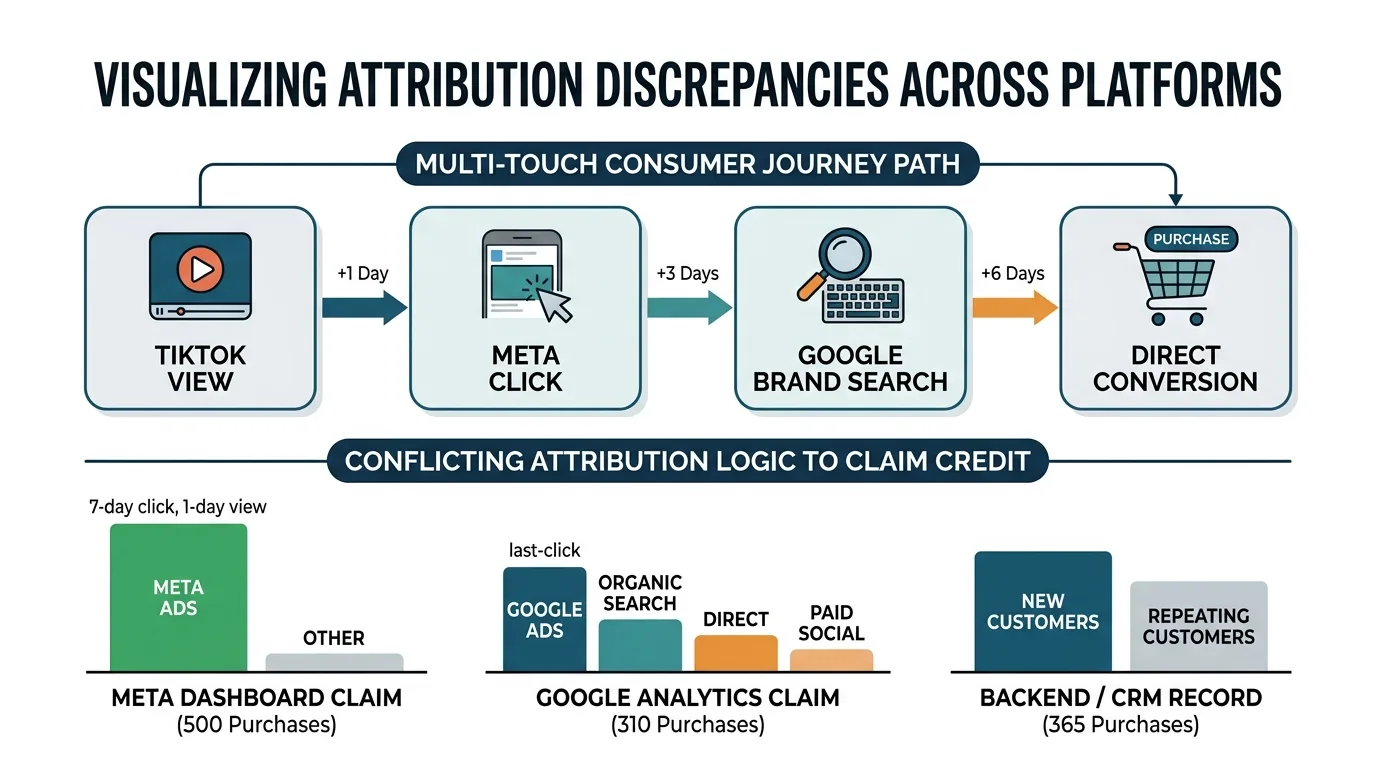
Discrepancies become a problem when teams compare numbers as though they came from the same instrument. They do not. Platform-reported conversions are designed to help platforms optimize delivery. Analytics tools are designed to organize site behavior. A CRM or order database is usually closest to the transaction itself, but it may not explain where demand originated.
The right operating model separates three questions: Did the transaction happen? Which channels likely created or captured demand? Which campaigns deserve more budget based on incremental business impact? Those answers may come from different data sources.
The Main Sources of Attribution Gaps
Different attribution windows
An attribution window defines how long after an ad interaction a platform can claim a conversion. Meta may credit a conversion after a view or click within its configured window. Google may assign credit based on a different click window. Your analytics platform may use a session-based model that gives credit only to the final known source.
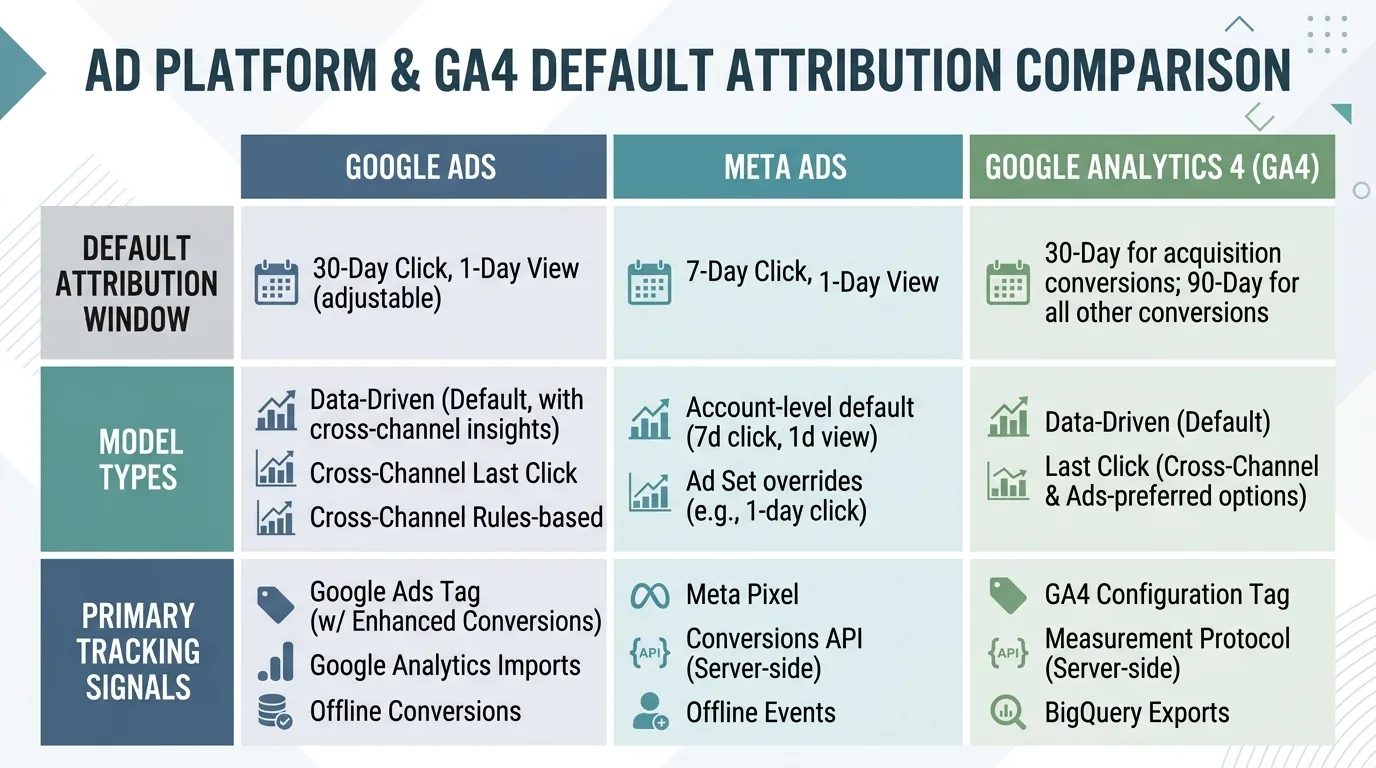
The difference is material. A product with a seven-day consideration cycle will look very different under a one-day click window than a seven-day click and one-day view window. Neither view is universally better. A short window can understate upper-funnel creative that initiates demand. A long window can overstate the role of a platform when customers would have converted anyway.
Before comparing performance, document the attribution settings in every reporting source. If the windows differ, the totals should differ.
Click-based, view-through, and engaged-view credit
A click is easier to defend than a view, but click-only reporting is not automatically more accurate. Many paid social campaigns create demand without generating an immediate click. A customer may see an ad, later search for the brand, and convert through an apparently direct or organic visit.
View-through attribution helps account for this behavior, especially in visual channels such as Meta, TikTok, and display. It also requires discipline. A large view-through conversion count can become an excuse to scale weak campaigns if it is not checked against blended revenue, new-customer volume, and controlled tests.
Use view-through data as a directional signal, not a blank check. It is most valuable when it moves in step with broader business outcomes.
Identity loss across devices and browsers
Customers do not behave like clean rows in a spreadsheet. They browse on an iPhone, compare products on a work laptop, then buy through an in-app browser or a desktop checkout. Cookies, device IDs, login states, consent choices, and browser restrictions all affect whether those sessions can be connected.
This is one reason last-click analytics frequently under-credits discovery channels. It is also why platform reporting may show conversions that never appear in a browser-based analytics tool. The platform may match an ad viewer to a purchaser using its own logged-in identity graph, while your analytics system sees two disconnected visits.
Privacy changes have made this more pronounced. Cookie restrictions, app tracking permissions, consent management platforms, and signal loss reduce deterministic tracking. Server-side event pipelines and first-party customer data can improve coverage, but they do not eliminate uncertainty.
Event setup and data quality problems
Not every discrepancy is a modeling issue. Some are implementation failures.
Duplicate purchase events can inflate platform conversions. Missing transaction IDs can prevent deduplication between browser and server events. A pixel firing on page load rather than confirmed order completion can count abandoned checkouts. Cross-domain checkout flows can break source continuity. Currency, tax, subscription, refund, or timezone settings can create revenue gaps that look like attribution problems.
These are operational issues, and they deserve an operational response. Audit the event flow from ad click to order record. Confirm that every primary conversion event has a unique ID, a clear firing condition, and a stable value definition. Then test the path on mobile and desktop, across the actual payment methods customers use.
Different channel definitions and default rules
One system may classify a visitor as paid social. Another may classify the same visitor as referral, direct, or unassigned because of missing parameters, redirects, or session expiration. Branded search often captures credit after social or display created awareness. Email and SMS can receive last-click credit after paid media did the expensive work of acquiring the customer.
Default channel groupings are convenient, not sacred. Teams need explicit naming conventions and campaign taxonomy across platforms. If creative, audience, market, offer, and funnel stage cannot be identified consistently, reporting becomes too fragmented to support fast decisions.
Reporting time and conversion time
Platforms can report a conversion on the date of the ad interaction, while your ecommerce system records it on the date of purchase. Conversion data can also arrive late as platforms process modeled events, offline uploads, or delayed payment confirmations.
This creates daily volatility that often disappears at a weekly or monthly view. Do not make major budget decisions from same-day platform reporting unless the conversion cycle is extremely short and data is validated. Mature acquisition teams use daily data for pacing and anomaly detection, then evaluate performance over a period that matches the buying cycle.
How to Diagnose Attribution Discrepancies Without Slowing Growth
Start by choosing a source of truth for actual business outcomes. For ecommerce, that is usually the order system, with clear rules for gross versus net revenue, cancellations, refunds, and new versus returning customers. For lead generation, it may be the CRM disposition and revenue data rather than a form submission. For apps, it may be a validated install, trial start, or subscription event.
Then create a reporting hierarchy. Backend revenue or qualified outcomes tell you whether the business is growing profitably. Platform reporting tells you what the buying algorithms are responding to. Analytics reporting explains paths, landing-page behavior, and channel interactions. Each layer has a job.
When a gap appears, isolate it before changing bids or cutting creative. Compare the same date range, timezone, conversion definition, and attribution window. Review whether the variance is concentrated in one platform, campaign type, device group, or checkout path. A sudden 40% gap is more likely to be an implementation or consent issue than a real change in customer behavior.
For teams spending at meaningful scale, keep a discrepancy log. Record when a change was introduced, such as a new consent banner, checkout provider, pixel update, domain migration, or campaign naming change. Measurement failures are easier to fix when they are treated like production incidents rather than vague reporting concerns.
Build a Measurement System That Supports Better Decisions
A clean measurement system does not require perfect agreement. It requires consistent definitions, reliable event collection, and decision rules that prevent overreaction.
Set a standard review cadence for blended metrics: total revenue, new-customer revenue, qualified leads, contribution margin, customer acquisition cost, and payback period. Review platform metrics alongside those outcomes, not in isolation. If a platform reports improving return on ad spend while blended customer acquisition cost rises, investigate before scaling. If platform attribution declines while total new-customer volume and profitable revenue rise, do not automatically cut the channel.
Creative testing matters here. New creative often reaches people who have not seen your brand before, which can make immediate platform efficiency look weaker than retargeting or branded search. Judge creative by its role in the system: Does it generate qualified traffic? Does it lift branded demand? Does it create incremental customers at an acceptable payback period? The answer depends on your funnel, sales cycle, and margin structure.
Where spend justifies it, use incrementality testing to challenge attribution assumptions. Geographic holdouts, audience splits, conversion lift studies, and controlled budget changes can reveal whether reported conversions represent real incremental value. These tests are not needed for every ad set, but they are essential when a channel is absorbing a large share of budget or producing claims that conflict with business results.
At Conversion Collective, this is why creative, media buying, and reporting should operate as one system. A winning ad is not just one with an attractive dashboard metric. It is one that can be launched, validated against business outcomes, and scaled with clear control over the signals that matter.
The practical standard is simple: trust your transaction data for what happened, use platform data to optimize how you buy, and keep testing the gap between reported performance and incremental growth. That discipline turns attribution uncertainty from a reporting argument into a better operating advantage.