
A freelancer can launch campaigns quickly. That is not the same as building a paid acquisition function that can absorb more spend, more creative, more channels, and more pressure without losing control. The managed media versus freelance buyers decision is really a decision about operating capacity: who owns the system behind performance when the stakes rise?
For a brand spending modestly on one platform with a proven offer, a strong freelance buyer can be an efficient answer. For a growth-stage business trying to find new winners every week, control CAC, and scale across Meta, Google, TikTok, Taboola, or custom channels, the model needs more than campaign management. It needs repeatable execution.
Managed Media Versus Freelance Buyers: The Core Difference
A freelance buyer is usually an individual operator. Their value comes from platform knowledge, hands-on optimization, and the ability to make informed decisions without agency overhead. The right person can be highly effective, especially when the account is focused, creative supply is steady, and internal leadership can provide clear direction.
Managed media is a broader operating model. It combines media buying, creative production, testing structure, campaign launches, reporting, and optimization into one accountable growth function. Rather than relying on one person’s available hours and preferred workflow, the program runs on shared systems, documented processes, and a team built to handle volume.
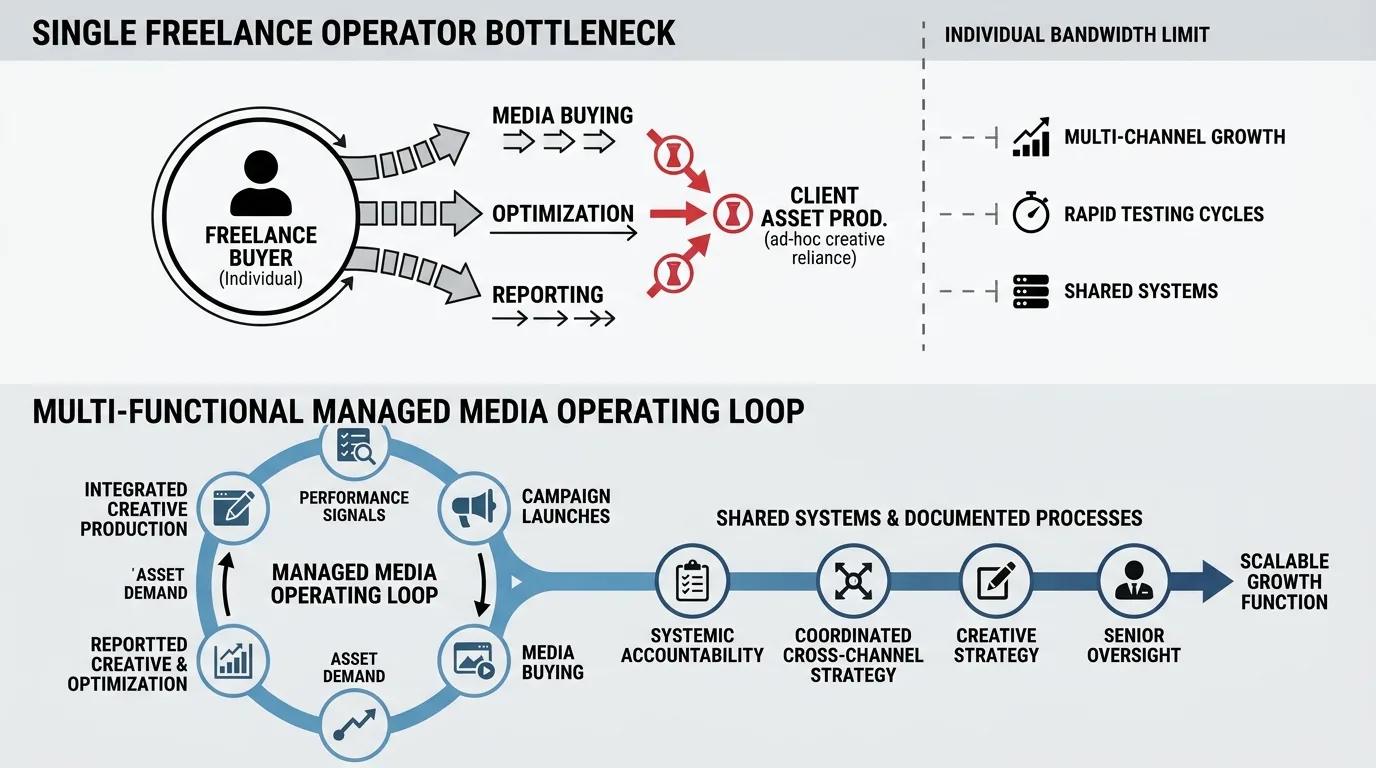
Freelance Buyers vs. Managed Media
| Operating Criteria | Freelance Buyer | Managed Media |
|---|---|---|
| Capacity & Bandwidth | Single-operator limits; constrained by individual hours | Multi-functional team; scalable shared infrastructure |
| Creative Workflow | Ad-hoc or client-provided asset reliance | Integrated creative production and rapid testing cycles |
| Multi-Channel Reach | Focused on 1-2 primary channels | Coordinated cross-channel strategy and execution |
| Operational Accountability | Execution of bids and budget tweaks | Systemic accountability for acquisition economics |
That distinction matters because paid acquisition rarely breaks from one bad bid adjustment. It breaks when creative arrives late, learnings are scattered, tests are poorly structured, launches are inconsistent, or nobody can explain why spend increased without a corresponding lift in profit.
A freelancer can be excellent at managing an account. A managed partner should be accountable for making the entire acquisition engine work together.
Where Freelance Buyers Can Be the Right Choice
Freelance media buyers are not a lesser option by default. They are often the right fit when the business has a narrow need and strong internal support.
If you are running a single primary channel, have an in-house creative team producing enough fresh assets, and need experienced execution rather than a full operating system, a freelancer may provide more direct access at a lower fixed cost. This can work particularly well for brands with stable offers, limited campaign complexity, or a senior growth leader who owns strategy and reporting.
The model also makes sense during a short-term transition. Perhaps a team needs coverage during a hire, wants an account audit, or needs help validating a new channel before committing to a larger engagement. In those cases, flexibility can outweigh infrastructure.
The trade-off is concentration risk. If one person owns strategy, campaign setup, analysis, and communication, their capacity becomes the account’s capacity. When creative volume rises or a second and third channel need attention, the account can become dependent on a single operator’s time and tribal knowledge.
Why the Model Often Breaks at Scale
Scaling paid acquisition creates more work than most teams expect. More budget requires more creative variation, tighter segmentation, faster testing cycles, stronger quality control, and better reporting. It also increases the cost of slow decisions.
A freelancer may still be capable of the work. The question is whether the surrounding system exists to support it. If they are waiting on internal designers, manually naming campaigns, building reports in spreadsheets, and translating platform results into creative direction alone, velocity falls before the team notices it.
The most common failure points are operational, not strategic:
- Creative production does not keep pace with spend, so the account relies too long on fatigued winners.
- Tests launch without a consistent hypothesis, making results difficult to compare or act on.
- Channel performance is viewed separately, hiding the broader economics of acquisition.
- Reporting explains what happened after the fact but does not identify the next actions clearly.
- Account knowledge lives with one person, making handoffs, vacations, and turnover expensive.
None of these issues are guaranteed with a freelancer. But they are harder to prevent when one person is expected to serve as media buyer, strategist, analyst, project manager, and creative feedback loop.
The Managed Media Advantage Is Coordination
The strongest managed media programs do not sell more meetings or more dashboards. They create coordination between creative and media so the account learns faster.
That starts with testing velocity. Media buying teams need a steady flow of static and video concepts built around clear angles, offers, hooks, formats, and audiences. Creative teams need performance feedback that goes beyond vague requests for “more winners.” They need to know which message, visual pattern, first-three-second hook, or landing-page promise is driving qualified conversions.
When these functions operate separately, the lag is costly. The buyer sees fatigue but waits for assets. The creative team produces volume without a clear performance brief. Spend moves before the next test is ready, and the account either stalls or wastes budget forcing scale through diminishing returns.
A managed model is designed to reduce that lag. The media and creative functions share a testing calendar, launch standards, naming conventions, performance signals, and decision cadence. Campaign execution becomes less dependent on memory and more dependent on a system.
This is where operational tooling matters. For example, centralized launch and campaign-management systems can standardize thousands of setups while keeping data organized across teams and channels. The point is not the tool itself. The point is making high-volume execution accurate enough that the team can focus on decisions instead of repetitive admin.
Cost Is More Than a Monthly Fee
Comparing a freelance rate to a managed media retainer can produce the wrong answer if the scope is not equivalent.
A freelancer’s fee may cover buying and optimization. A managed engagement may include the workflows that support profitable scale: creative strategy, asset production, test design, launch operations, reporting, cross-platform management, and senior oversight. One cost buys an individual contributor. The other buys a coordinated performance function.
That does not mean managed media is always more economical. A lean business with low spend can overbuy capacity. Paying for a full growth engine before there is enough budget, offer validation, or creative demand to use it is inefficient.
But underbuying is costly too. If a brand spends heavily while cycling through freelancers, losing historical context, delaying creative tests, and reacting to performance instead of directing it, the apparent savings disappear in wasted media spend and missed growth windows.
The more useful question is: what is the cost of not having a reliable testing and optimization cadence at our current spend level?
How to Choose Between the Two Models
Start with the complexity of the growth problem, not the title of the provider. A freelancer is often enough when the task is discrete and the business can supply the surrounding resources. Managed media is more appropriate when the business needs someone to own the machine, not just the ad account.
Ask whether your team can consistently answer four questions. How many new creative concepts can we test each week? How quickly can we turn performance data into the next set of ads? Who owns results across channels rather than inside platform silos? And what happens if the person running media is unavailable for two weeks?
If the answers are clear, a freelancer may fit well. If the answers depend on improvisation, the business likely has an operating problem that another individual hire will not solve.
Also examine incentives. Some providers benefit as spend rises, whether or not efficiency holds. A better partnership is built around the economics that matter to the business: profitable customer acquisition, useful learning velocity, contribution margin, and durable growth. Spend is an input, not the score.
What Good Accountability Looks Like
Whether you choose a freelancer or a managed partner, demand clarity on ownership. A good operator should explain what they are testing, why it matters, what would prove the test wrong, and what decision follows from the result.
Reporting should identify movement in the numbers and the actions behind it. If CPA rises, was the cause creative fatigue, audience saturation, landing-page conversion, tracking quality, bid strategy, or channel mix? If a new campaign wins, can that learning be translated into more creative and more scalable variations?
Conversion Collective approaches this through an integrated creative and media system because performance signals lose value when they sit in separate teams. The goal is not to produce activity. It is to identify winners quickly, cut waste, and give scaling decisions a clear operational foundation.
The right choice is the model that matches your current complexity while leaving room for the complexity you are actively creating. If growth depends on moving faster without creating chaos, choose the partner with a system that can keep pace with the opportunity.