
A mobile app can buy 100,000 installs and still have an acquisition problem. If those users do not activate, subscribe, purchase, or return often enough to cover their acquisition cost, the install count is just an expensive vanity metric. This app acquisition example shows what a controlled paid growth system looks like when the objective is profitable scale, not cheap traffic.
The scenario is illustrative, but the operating model applies to subscription apps, utility products, marketplaces, fintech apps, and any business that depends on paid users becoming measurable revenue.
The app acquisition example: from stalled growth to control
Consider a consumer subscription app with a useful product and a functioning onboarding flow. It has proven that users will pay, but its paid growth program is stuck. Meta campaigns produce installs at an acceptable cost, yet trial-to-paid conversion varies wildly by week. TikTok delivers low-cost downloads but weak retention. Google App campaigns bring higher-intent users, though volume is limited.
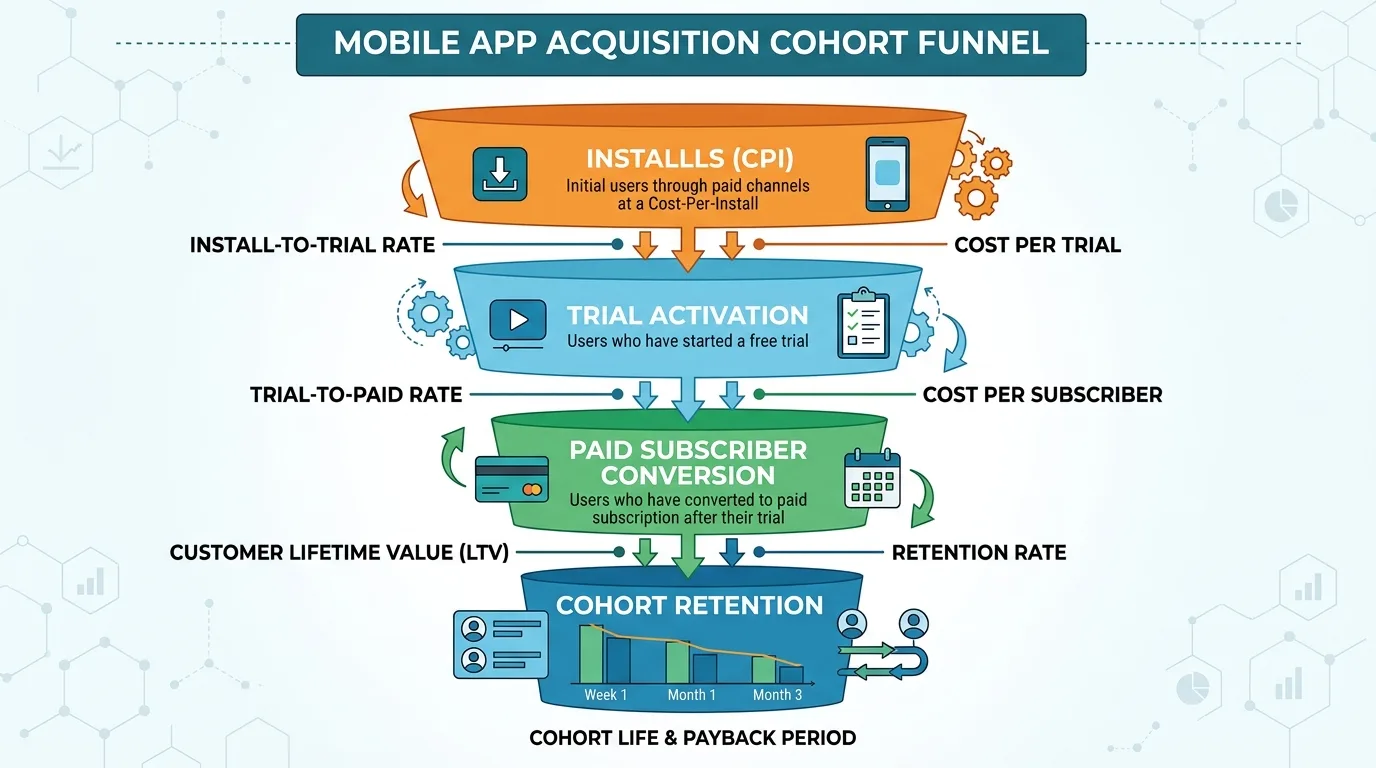
The team has a familiar problem: each channel is being judged by a different metric, creative production is too slow to create meaningful learning, and media buyers are making budget decisions from incomplete data. The result is inconsistent scaling. Spend rises when a platform looks good in-platform, then gets cut when finance sees weak payback later.
The fix is not simply adding budget or launching on more channels. The fix is building one acquisition system that connects creative, media execution, event quality, and cohort economics.
Start with the revenue event, not the install
The app’s original optimization target is cost per install. That is appropriate for early delivery when an account needs volume and platform signals, but it cannot be the final decision metric. The real target might be a completed trial, first purchase, qualified lead, or predicted subscriber value, depending on the product and available data.
For this example, the team defines success as a paid subscriber who remains active through the first billing cycle. They also track the leading indicators that explain whether the campaign is moving toward that outcome: install-to-registration rate, registration-to-trial rate, trial-to-paid rate, cost per trial, and early retention.
This changes the conversation immediately. A creative with a $3 install cost is not automatically better than one at $5. If the $5 creative attracts users who begin trials at twice the rate and pay at a materially higher rate, it may produce the lower cost per subscriber and faster payback.
That distinction is where many app acquisition programs lose money. The team optimizes for the easiest event to buy instead of the event that creates revenue.
Build creative around conversion hypotheses
High-velocity creative is not a volume contest. Its job is to answer specific questions quickly enough that budget can move toward winners before market conditions change.
In this example, the app has been running polished brand videos focused on broad claims such as saving time and improving daily habits. They generate attention, but the message is too generic to qualify users. The new creative plan is organized around four hypotheses:
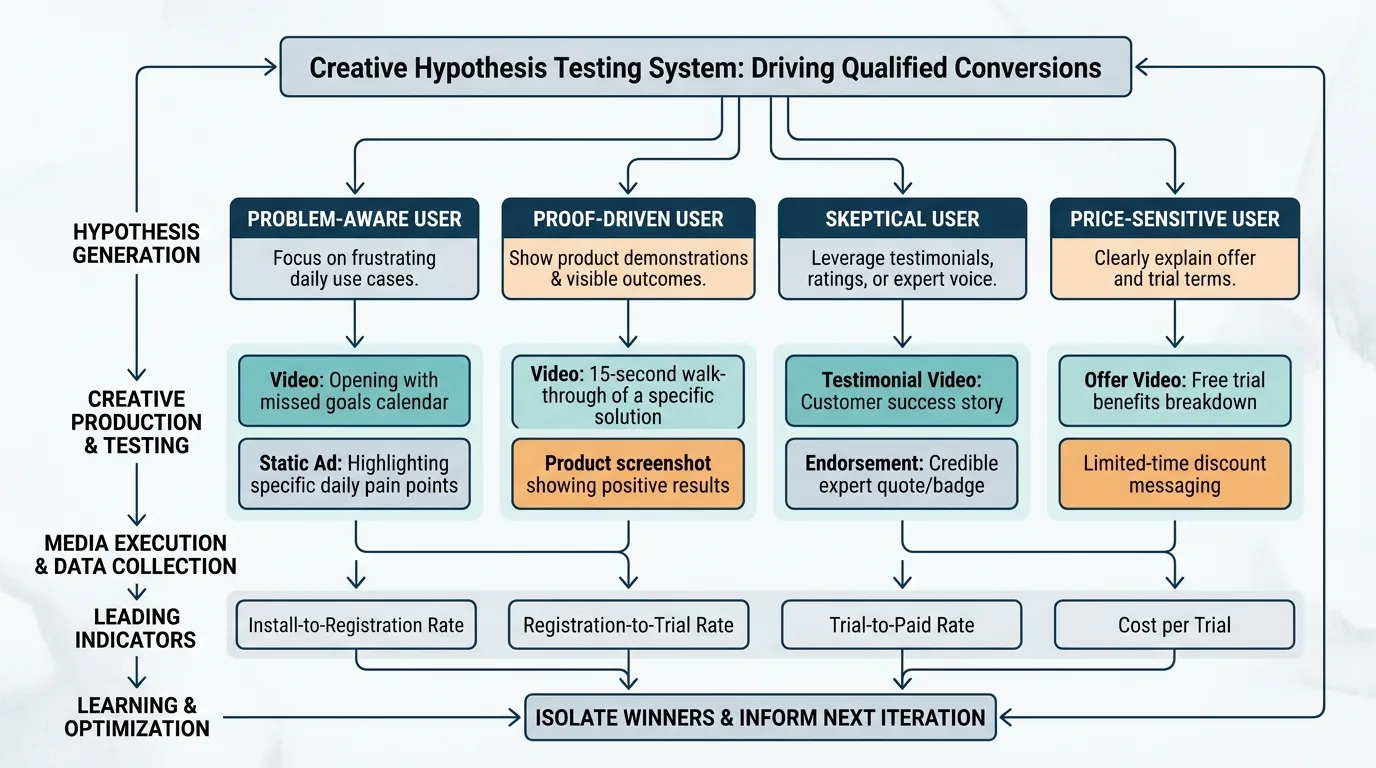
- Problem-aware users will respond to ads that name a frustrating daily use case.
- Proof-driven users will respond to product demonstrations and visible outcomes.
- Skeptical users will need testimonials, ratings, or a credible expert voice.
- Price-sensitive users will convert when the offer and trial terms are explained clearly.
Each hypothesis becomes a batch of static and video concepts, not a single ad. The team varies the opening hook, visual proof, offer framing, creator style, and call to action while preserving a clear learning agenda. For a habit-tracking app, one concept might open with a calendar full of missed goals. Another might show a 15-second walkthrough of the product solving that exact problem. A third might use a customer explaining why they stayed after the free trial.
The goal is to isolate what earns attention and what drives qualified action. If a creator-led testimonial produces strong trial quality but low click-through rate, that is useful information. It may be a scalable lower-funnel asset rather than a prospecting winner. A disciplined team does not kill it solely because its click metric looks weaker than a flashy video.
Give creative enough spend to produce a signal
Premature decisions are expensive. Cutting every ad after a few hundred impressions produces noise, not learning. Leaving weak ads active for weeks wastes budget. The right threshold depends on the app’s conversion volume, target CPA, event lag, and channel.
A practical operating rule is to set test budgets and decision windows before launch. For fast events such as registrations or trials, early signals may be available in one to three days. For subscription conversion or retention, the team needs a longer cohort window. That does not mean waiting passively. It means using leading indicators to manage spend while reserving final judgment for the metric that matters.
Creative and media should review results together. A media buyer can see placement, audience, and delivery patterns. A creative strategist can see whether the hook, proof, or offer is carrying the result. Separating those functions slows iteration and creates vague feedback such as “make it more engaging.”
Launch channels with distinct jobs
Not every paid channel should be asked to do the same thing. In this app acquisition example, Meta is the primary testing and scale channel because it can quickly distribute a broad creative library and find responsive audiences. Google App campaigns capture high-intent demand and support efficient incremental volume. TikTok is used selectively to find new creative angles and reach audiences that respond to native, creator-style storytelling.
That does not mean every app needs all three. A high-consideration financial app may find Meta and Google more productive than TikTok. A visually compelling consumer app may earn its best first-touch results on TikTok but require retargeting elsewhere to close the conversion gap. Channel selection should follow the economics and the creative fit, not a generic media mix.
The critical point is unified measurement. Every channel should report against the same event definitions, attribution rules, and cohort windows. If Meta is evaluated on seven-day click attribution while TikTok is evaluated on installs and Google on last-click subscriptions, the team is not comparing performance. It is comparing incompatible reports.
Scale budgets without resetting performance
Once several creatives demonstrate efficient subscriber acquisition, the app moves from testing mode to controlled scaling. Budget increases happen in increments that preserve visibility into what caused performance to change. A sudden 300% increase may push delivery into less qualified inventory, exhaust a small audience, or cause the platform to redistribute spend away from the actual winner.
The team scales at the campaign, ad set, and creative level based on where the constraint sits. If a winning creative is capped by budget but audience quality remains stable, increasing spend is logical. If frequency rises and conversion rate declines, the next move may be new creative rather than more budget. If a campaign performs well only on retargeting, it cannot be treated as scalable prospecting volume.
This is also where campaign organization matters. Clear naming conventions, consistent event mapping, controlled launch processes, and centralized reporting are operational requirements. Without them, a growing account becomes a collection of duplicate campaigns, unclear tests, and unexplained spend. Internal systems that standardize launches and aggregate results give the team the speed to run more tests without introducing chaos.
Read cohorts before declaring a winner
The best-performing acquisition ad is not always the one with the lowest immediate CPA. A discount-led message may create a surge in trials, then attract users who cancel before the second billing cycle. A more direct product demonstration may cost more upfront but produce users with higher retention and lifetime value.
For that reason, the app reviews cohorts by source, campaign, creative theme, and offer. It asks whether users acquired from a particular message are activating faster, retaining longer, or generating more net revenue after refunds and payment failures. This is where media buying becomes a growth function rather than an install-buying function.
There are trade-offs. Long retention windows improve confidence but delay decisions. Short windows support speed but can overstate value. The practical answer is to use a layered measurement model: early signals for daily optimization, mature cohorts for budget validation, and periodic holdout or incrementality testing when spend is large enough to justify it.
What changes when the system is working
Within several weeks, the app should know more than which ad has the cheapest install. It should know which messages attract durable users, which channels can absorb more budget, which offers improve conversion without damaging retention, and where onboarding friction is limiting paid growth.
That clarity is the advantage. Conversion Collective approaches paid acquisition as one integrated system because creative insights should change media decisions, and media data should change the next creative batch. When those feedback loops run quickly, teams stop guessing at scale.
The next useful move is not to ask for more installs. Ask which user cohort creates profitable growth, then build the testing and media system required to find more of them.