
A lead form can fill a CRM fast and still damage the business. The best ad formats for leads are not the ones that produce the lowest cost per submission. They are the formats that create enough qualified demand for your sales process, preserve margin after follow-up costs, and can be tested at a pace that keeps spend moving toward winners.
That distinction matters when budgets increase. A cheap lead source with weak intent can overwhelm sales reps, inflate reported volume, and quietly push customer acquisition cost higher. The right format depends on the offer, the buying cycle, the qualification standard, and how quickly your team can contact a prospect.
What Makes an Ad Format Work for Lead Generation?
Format is the delivery mechanism for an exchange: attention for information, a quote, a demo, a consultation, or an application. It should reduce friction only where friction is not serving a qualification purpose.
For a low-consideration offer, removing steps can improve both conversion rate and scale. For a high-ticket B2B service, a little more friction can protect the sales team from poor-fit inquiries. A mortgage quote, legal case evaluation, or enterprise software demo should not be optimized with the same playbook as a newsletter signup or a local service estimate.
Evaluate formats against downstream metrics, not platform metrics alone. Cost per lead is useful for spotting delivery issues, but cost per qualified lead, booked-call rate, show rate, close rate, and contribution margin tell you whether an ad format deserves more budget. If conversion data arrives slowly, use leading indicators such as verified contact rate, qualification answers, or speed-to-lead response as interim signals.
Best Ad Formats for Leads by Buyer Intent
Search ads for active demand
Google Search remains one of the strongest formats when prospects already know the problem and are looking for a solution. Text ads tied to high-intent queries work especially well for services with clear demand: insurance, home services, legal, healthcare, B2B software, and financial products.
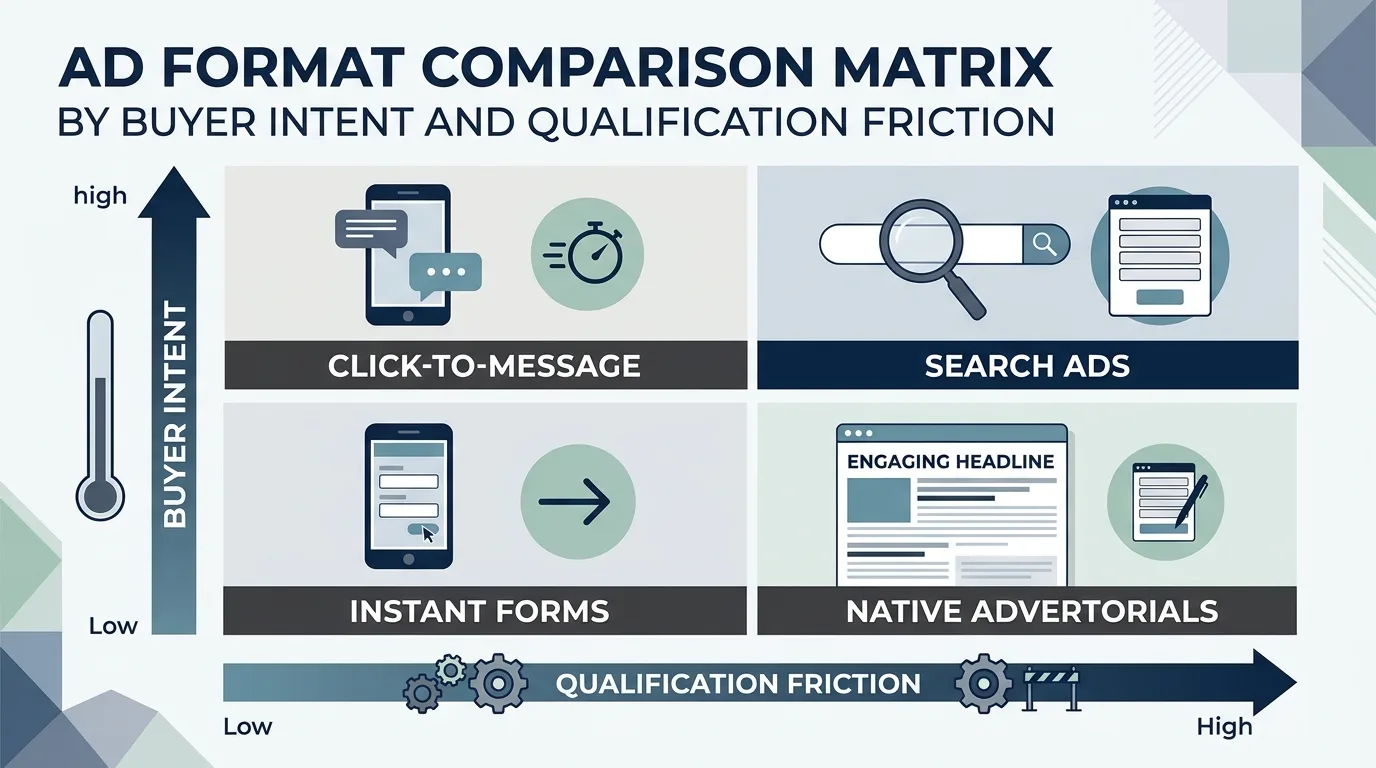
Ad Format Intent and Qualification Comparison
| Option | Intent Level | Friction | Use Case |
|---|---|---|---|
| Search Ads | High | High | Active demand capture |
| Instant Forms | Low to Medium | Low | Rapid volume capture |
| Click-to-Message | Medium | Medium | Consultative sales dialogue |
| Native Advertorials | Low | High | Educational complex offers |
Search is not always the cheapest source of leads, and it rarely creates demand on its own. It earns its place because the user has declared intent. Match the landing page tightly to the query, make the next step clear, and separate informational searches from purchase-ready searches. Sending both groups to the same generic form usually wastes valuable signal.
For high-value leads, use a landing page with qualification fields rather than relying on a single conversion event. The goal is not just to capture the click. It is to identify which queries produce prospects your sales team can actually convert.
Meta instant forms for efficient volume
Meta lead ads reduce the number of steps between interest and submission. Pre-filled contact details and in-platform forms can generate volume quickly, making them useful for local services, consumer offers, newsletters, event registrations, and broad prospecting campaigns.
The trade-off is lead quality. Because the user does not need to visit a site or complete a full landing-page experience, low-intent submissions are common. This does not make instant forms a bad format. It means the form needs controls.
Use higher-intent form settings when sales quality matters. Add one or two questions that reveal fit, set clear expectations in the ad and form intro, and filter obvious mismatches before they hit the CRM. Then connect submitted leads to immediate follow-up. If your first call happens hours later, the format’s speed advantage disappears.
Click-to-message ads for consultative offers
Click-to-message ads on Meta can outperform forms when a prospect needs reassurance before committing. They work well for service businesses, education, cosmetic procedures, real estate, high-ticket ecommerce, and offers where eligibility or pricing requires a conversation.
A message is not automatically a qualified lead. The conversation flow needs a job: identify need, collect key details, direct the prospect to book, and hand off to a human when intent is clear. Open-ended chats without routing logic create a new operational bottleneck.
This format is most effective when response time is measured in minutes, not business days. Automated first responses can keep momentum, but a scripted bot should not trap a serious buyer in a loop. Build an escalation path for sales or customer support.
Short-form video for creating demand
TikTok, Reels, and other short-form video placements are often stronger at generating interest than harvesting existing intent. They give you room to demonstrate a problem, challenge a common assumption, show social proof, or explain an offer that people were not actively searching for.
For lead generation, the first seconds matter more than polished production. Start with the pain point, outcome, or qualification cue. A founder-led explanation, customer-style testimonial, product demonstration, or direct-response talking-head video can all work if the message is specific.
Video is not a format to judge after one creative. Performance comes from volume and iteration. Test different hooks, claims, proof points, audiences, and calls to action while keeping the offer stable enough to identify what caused the result. A winning angle can then be adapted into static ads, native placements, and landing-page headlines.
Native advertorials for complex consideration
Native placements on platforms such as Taboola can be effective when the offer requires education before a form fill. An advertorial-style landing page gives prospects context that a small ad unit cannot: the problem, the mechanism, supporting proof, objections, and the next step.
This is a better fit for complex products, health and wellness offers with compliant messaging, financial education, subscription products, and lead-gen funnels where the buyer needs to understand why the offer is relevant. The creative must earn the click without misleading the user. Curiosity can drive cheap traffic, but curiosity alone rarely produces qualified leads.
Native campaigns require strong pre-lander and landing-page measurement. Track scroll depth, page engagement, form starts, and submitted leads by placement. A placement that looks efficient at the click level can be unprofitable once downstream behavior is visible.
Static ads with dedicated landing pages
Static image ads remain one of the most scalable lead formats because they are fast to produce, easy to test, and flexible across platforms. A clear visual, a sharp benefit statement, proof, and a direct call to action can outperform more expensive video when the offer is already understood.
Their advantage is testing velocity. You can launch multiple variations around one offer without waiting for a major production cycle. Test audience-specific headlines, testimonial proof, problem-first messaging, price or incentive framing, and different visual treatments. Pair each meaningful angle with a landing page that continues the same promise.
Match the Format to Your Sales Motion
The right choice depends on what happens after the lead submits. If your team closes low-ticket offers quickly, instant forms and message ads can be efficient. If a sale requires a discovery call, multiple stakeholders, or compliance checks, use a landing page and qualification flow that prepares both the buyer and your sales team.
Also consider demand temperature. Search ads capture prospects already looking. Meta and TikTok prospecting create demand and need stronger creative. Native advertorials are useful when education sits between awareness and action. Most scaled lead programs use more than one format because no single source can efficiently cover every stage.
Build a Testing System, Not a Format Preference
Treat formats as testable vehicles, not permanent channel decisions. Start with a defined conversion event and a quality feedback loop from the CRM. Then test one variable at a time whenever possible: the offer, creative angle, form friction, landing-page message, or audience.
Creative and media buying should operate as one system. Media data identifies which messages and placements deserve more testing. Creative production turns those signals into new variations quickly. Sales data confirms whether the apparent winner produces revenue, not just form fills.
Avoid making decisions from a small number of leads. A format may show a higher cost per lead but produce materially better show rates and close rates. Another may look efficient for two days before quality drops as the platform expands delivery. Set decision windows based on your sales cycle and conversion volume, then move budget deliberately rather than reacting to every daily fluctuation.
Optimize the Follow-Up Path After the Click
No ad format can compensate for slow lead handling. Route leads instantly, verify contact information where appropriate, and measure time to first outreach. For phone-based sales, contact speed often has more impact on outcomes than another round of targeting adjustments.
Review call outcomes and rejection reasons alongside ad data. If leads consistently lack budget, change the message or add a qualifying question. If they do not understand the offer, fix the ad-to-page handoff. If they are a good fit but do not book, improve the scheduling path and follow-up sequence.
The best lead format is the one that your full acquisition system can convert profitably. Start with the buyer’s intent and the sales motion, test creative at enough volume to find real winners, and let revenue quality decide where the next dollar goes.