
A weak creative brief does not create a weak ad. It creates a weak test. The distinction matters because paid acquisition teams do not need more polished concepts sitting in a folder. They need a reliable way to launch, measure, learn, and produce the next round before spend drifts toward fatigue or wasted impressions. Knowing how to brief performance creatives is how you turn creative production into an operating system for profitable growth.
The best briefs reduce ambiguity without reducing the creative team’s ability to find a sharper execution. They give designers, editors, copywriters, and media buyers the same definition of the job: which audience problem to address, which message to test, which proof to use, and what result will determine whether the concept earns more spend.
Start With the Performance Problem, Not the Asset
“We need five TikTok videos” is not a performance brief. It is a production request. It tells a team what to make, but not why it should exist or what decision the resulting data needs to support.
Start with the business and media context. Is the account struggling to acquire new customers below a target CAC? Has a formerly strong angle reached frequency limits? Is the goal to improve lead quality, increase trial starts, or find a message that can open a new audience segment? A brief should state the constraint plainly.
For example: “Current Meta prospecting creative converts well with price-sensitive shoppers but does not move premium buyers. Test whether product durability and long-term cost savings can increase qualified purchases while holding CAC within 10% of the current baseline.”
That gives the team a real assignment. It also prevents a common failure mode: judging creative only on click-through rate when the actual issue is conversion quality or payback period.
Define the Hypothesis Before You Define the Concept
Performance creative should be built around a claim that can be tested. A creative concept is the execution of that claim. When teams skip the hypothesis, every new ad becomes a bundle of changing variables - new hook, new offer, new format, new landing page message - and the result is difficult to interpret.
A usable hypothesis has three parts: the audience, the message or mechanism, and the expected outcome. For instance: “For busy parents researching better-for-you snacks, leading with ingredient transparency and a lunchbox use case will outperform broad taste claims because it answers a daily purchase decision.”
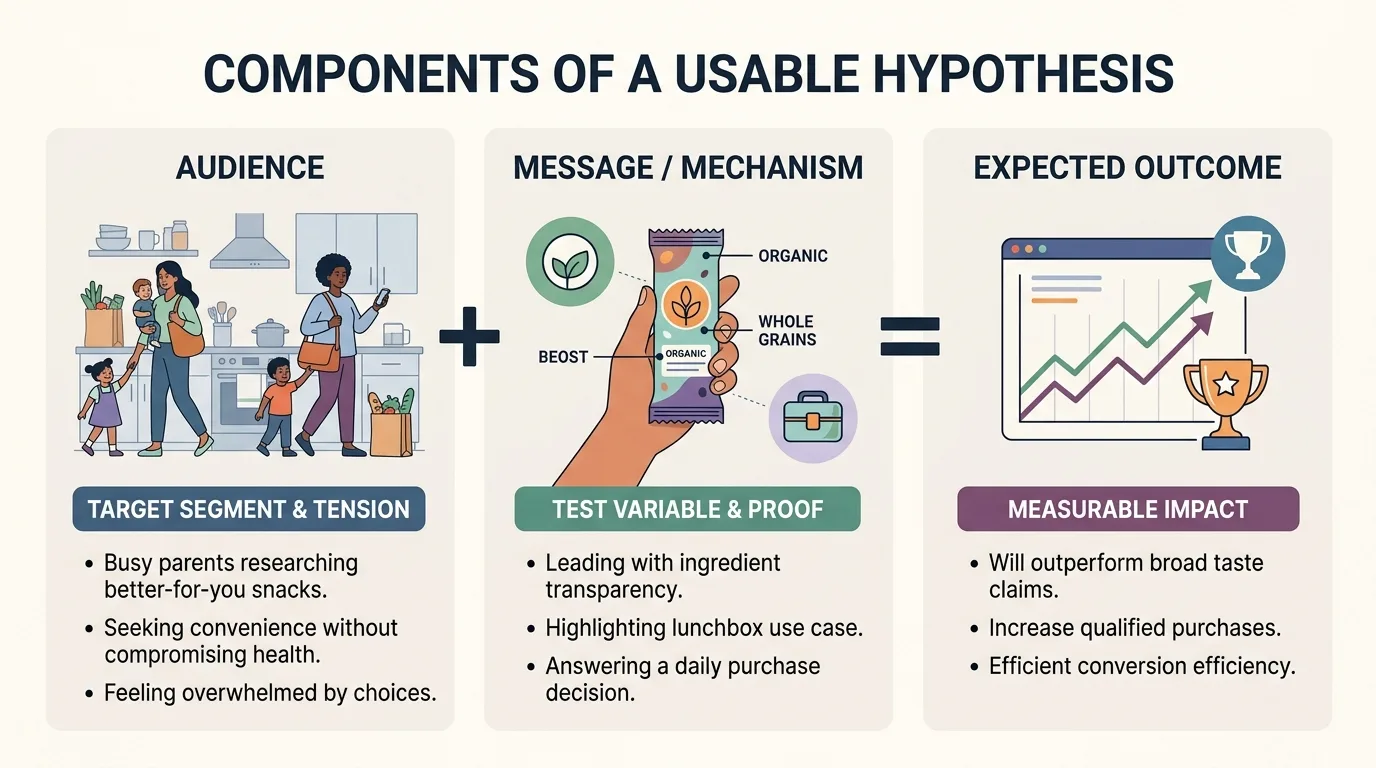
The creative team can now develop multiple expressions of the same idea: a founder-style video, a comparison static, a customer testimonial, or a fast product demo. Those executions may perform differently by platform, but they are all helping answer the same question.
This is where creative and media need to operate as one system. The media buyer knows where delivery is weakening, which segments are scaling, and what success threshold matters. The creative team turns those signals into testable work. Separating those functions creates attractive ads with no learning agenda.
How to Brief Performance Creatives With Enough Context
A strong brief does not need to be long. It needs to be specific where specificity changes execution. Give the team the inputs that help them make better decisions, then leave room for judgment on pacing, visuals, and storytelling.
The Performance Creative Brief Checklist
Before production begins, ensure you have ticked every box in this strategic framework:
- Objective and Optimization: Clear target action defined (e.g., subscription, purchase).
- Audience and Tension: A clear description of the specific user pain point.
- Core Angle: The single core hypothesis or message being isolated.
- Supporting Proof: Valid customer reviews, statistics, or demos ready to use.
- Offer and Call to Action: Explicit commercial offer and exact destination URL.
- Format and Constraints: Platform-specific dimensions and duration limits.
- Success Metrics: Defined goals (e.g., hold rate, cost-per-acquisition).
Every performance creative brief should cover these seven areas:
- Objective and optimization event: State the desired action, whether that is a purchase, qualified lead, install, subscription, or another measurable conversion.
- Audience and moment: Describe who the ad is for and the situation that makes the message relevant. “Women 35-54” is targeting, not insight.
- Core angle: Identify the single message being tested, such as speed, savings, social proof, problem avoidance, status, or a differentiated mechanism.
- Proof: Supply the evidence that makes the claim believable. This can include reviews, product demonstrations, expert validation, data, before-and-after evidence, or a clear explanation of how the product works.
- Offer and CTA: Include the exact offer, required language, destination, and action. Do not make the team infer commercial details from an old campaign.
- Format and platform constraints: Specify placements, aspect ratios, duration ranges, brand requirements, and platform-specific considerations. A 30-second Meta feed video and a six-second TikTok hook are not interchangeable assignments.
- Success criteria: Define what a winner looks like and what comparison set will be used. This may be CPA, conversion rate, hold rate, qualified-lead rate, revenue per click, or blended efficiency.
The audience section deserves more rigor than most briefs receive. Instead of writing “small business owners,” explain the tension: “Operators managing field teams who lose time chasing paperwork and worry they are missing billable hours.” That language produces a more credible hook, stronger visual choices, and copy that sounds like it understands the buyer.
Separate the Test Variable From the Production Variables
High-velocity testing does not mean launching random variations. It means controlling enough of the test to learn quickly.
If the angle is the variable, keep the offer and primary audience consistent across the first round. If the goal is to find the strongest hook, do not also change the product demonstration, headline, testimonial, and CTA in every version. You may get a winner, but you will not know what made it win.
That said, rigid control is not always practical. Some platforms reward native creative so heavily that the format itself changes performance. On TikTok, a creator-led delivery may be necessary to give an angle a fair chance. On Meta, the same message might need statics, short-form video, and catalog-adjacent executions to capture different consumption behaviors. The answer is not to avoid format variation. It is to document what changed and structure the launch so the results remain useful.
A practical first round might test three angles with two executions each. Once an angle proves it can generate efficient conversions, expand it into new hooks, proof points, formats, and audience-specific versions. That sequence protects production capacity and keeps the pipeline focused on signals, not opinions.
Give Creators Source Material They Can Actually Use
Generic brand decks are rarely enough. A creative team cannot make a convincing performance ad from a logo, product shots, and the phrase “premium quality.”
Provide raw customer language from reviews, sales calls, support tickets, surveys, and comments. Include the objections buyers raise before converting, the alternatives they compare you against, and the exact outcomes customers describe after purchase. These inputs are often more valuable than approved marketing copy because they reveal the words customers already use to explain the problem.
Also provide usable proof assets. If the brief calls for a product demonstration, share the footage or a clear shot list. If it calls for a claim about savings, give the calculation and legal approval. If it relies on a testimonial, provide the full quote and permission status. Missing inputs create production delays, watered-down claims, and unnecessary revision cycles.
Build Clear Guardrails Without Writing the Ad for Them
A brief should establish non-negotiables: compliance requirements, prohibited claims, visual brand rules, mandatory disclosures, and offer accuracy. It should not prescribe every line of dialogue or every frame unless the test specifically requires it.
Over-directing is expensive. It turns experienced creative operators into order takers and slows iteration when the first concept needs adjustment. Better briefs define the strategic destination and the evidence available, then ask for platform-native executions that earn attention quickly.
For video, specify what must happen early. The first one to three seconds should establish a problem, outcome, pattern interrupt, or recognizable use case. That does not mean every ad needs an exaggerated hook. For higher-consideration products, clarity can outperform spectacle. The right opening depends on audience awareness, price point, platform, and the amount of proof needed before conversion.
Close the Loop After Launch
The brief is not finished when the files are delivered. It becomes more valuable after performance data comes back.
Review results with creative and media teams together. Identify whether the winning signal came from the angle, hook, proof type, creator, visual format, offer framing, or audience-message match. Then convert that finding into the next brief.
Avoid declaring victory too early. An ad with a low CPA on limited spend may be a useful seed, not a scalable winner. Look at its ability to hold efficiency as spend increases, its conversion quality, and whether it can produce adjacent variations without collapsing. Conversely, a creative that misses the target may still reveal that the audience responds to a specific objection or proof point.
The operational goal is a compounding learning loop: brief, produce, launch, measure, iterate. When briefs carry forward what the account has already learned, creative volume becomes controlled experimentation rather than content churn.
The next time performance stalls, do not ask for more ads. Ask which customer tension, proof point, or buying objection the next round needs to resolve. That question produces a brief your team can execute quickly - and results your media team can actually scale.