
A $100,000 monthly media budget can underperform for a simple reason: the ads arrive too slowly, the buyer lacks context on the creative, or the creative team never sees the placement-level data. The creative agency vs media agency decision is not primarily about who has better ideas or lower fees. It is about whether your paid acquisition system can find winners, learn from them, and scale them before the market moves on.
For growth-stage businesses, the distinction matters because paid media performance is increasingly determined by the connection between creative output and media execution. A polished campaign that launches once per quarter is not built for high-velocity acquisition. Neither is a media program that optimizes bids and audiences while treating creative as a static input.
Creative Agency vs Media Agency: The Operating Difference
A creative agency is typically responsible for the message, the visual system, and the assets people see. Its work may include brand strategy, campaign concepts, copywriting, design, video production, landing pages, and social content. The best creative agencies can sharpen positioning and produce work that makes a brand more memorable.
A media agency is typically responsible for getting that work in front of the right audiences. Its scope often includes media planning, channel selection, budget allocation, campaign setup, bidding, targeting, optimization, and reporting. A capable media agency helps determine where spend goes and how efficiently each channel produces an outcome.
Those roles are valid. The problem begins when they operate as separate production lines in a performance environment. Creative receives a brief, works through approvals, and delivers a finite batch of assets. Media launches the assets, reports results, and requests revisions weeks later. By the time the next round is live, the original performance signal may be irrelevant.
Agency Model Comparison
| Focus Area | Creative Agency | Media Agency |
|---|---|---|
| Core Focus | Brand identity, asset design, copywriting, and brand message | Channel strategy, budget management, and campaign setup |
| Timeline | Longer, campaign-based production cycles | Rapid, platform-level testing and distribution |
| Primary Optimization | Attention, brand recall, and production quality | Spend efficiency, CPM, CPC, and conversion metrics |
| Key Vulnerability | Disconnect from immediate performance data | Inability to scale without continuous creative assets |
That workflow can work for a major brand campaign where consistency and reach matter more than immediate conversion data. It is a poor fit for ecommerce brands managing volatile customer acquisition costs, lead generation teams optimizing toward qualified leads, or app marketers balancing install volume with downstream revenue.
What a Creative Agency Usually Optimizes For
Most creative agencies are designed to improve perception. They focus on the quality of the idea, adherence to brand standards, production value, and the cohesiveness of a campaign. Those priorities matter, especially when a company is refining its market position or launching a product that needs a distinct narrative.
But brand-quality work and performance-ready work are not always the same thing. A high-production video may earn positive internal feedback and still lose to a direct founder-led testimonial, a simple static comparison, or an ugly-but-clear offer ad. In paid acquisition, the market gets the deciding vote.
Creative agencies may also work on longer timelines. That is reasonable when assets require location shoots, animation, extensive legal review, or a new brand platform. It creates friction when a media team needs 20 fresh variations this week to test new hooks, angles, proof points, formats, and calls to action.
A creative partner is the right fit when the central problem is brand definition, a major campaign concept, or premium production. It becomes less effective when your main constraint is testing velocity and you need creative decisions tied directly to conversion outcomes.
What a Media Agency Usually Optimizes For
A media agency generally focuses on distribution efficiency. It manages channel strategy, account structure, budgets, targeting, pacing, and optimization. For a business spending across Meta, Google, TikTok, Taboola, and other channels, this discipline is essential. Poor campaign architecture and delayed budget decisions can waste meaningful spend quickly.
The limitation is that media buying cannot compensate indefinitely for weak or exhausted creative. Once a buyer has tested audiences, placements, bidding strategies, and budget levels, creative often becomes the largest remaining lever. If new assets are limited, the agency may keep making smaller account-level adjustments while performance deteriorates.
This is why media reporting can become misleading. A dashboard may identify that cost per acquisition is rising, but it may not explain which hook stopped working, which audience responds to a different promise, or why one visual format produces higher-quality customers. Those answers require structured creative testing, not just campaign optimization.
A media agency is the right fit when you have a strong internal creative engine that can reliably deliver channel-ready assets, fast. If that engine is slow, disconnected, or built around subjective approvals, media buying alone will hit a ceiling.
The Cost of Separating Creative From Media
Fragmentation creates more than inconvenience. It slows the feedback loop that produces profitable growth.
When separate partners own creative and media, each may optimize for its own output. The creative team ships assets. The media team manages spend. Neither owns the full system from hypothesis to result. Feedback gets reduced to broad requests such as “make more videos like the winner,” which is rarely specific enough to create useful iterations.
The deeper issue is attribution of learning. A winning ad is not simply a finished asset to replicate. It is evidence. It may show that a particular customer problem is urgent, a certain claim is credible, a creator format earns attention, or a benefit performs best with a particular audience and placement. That evidence should immediately shape the next batch of tests.
Without an integrated process, teams also lose time to handoffs. Media buyers wait for assets. Designers wait for feedback. Leadership receives reports that describe what happened but not what should be produced next. Meanwhile, spend continues against a shrinking pool of ads.
The Better Model: One Paid Growth System
For performance-driven businesses, creative and media should operate as one managed acquisition function. That does not mean every ad needs to look the same or that brand standards disappear. It means the teams share a testing plan, use the same performance definitions, and make decisions from a common source of data.
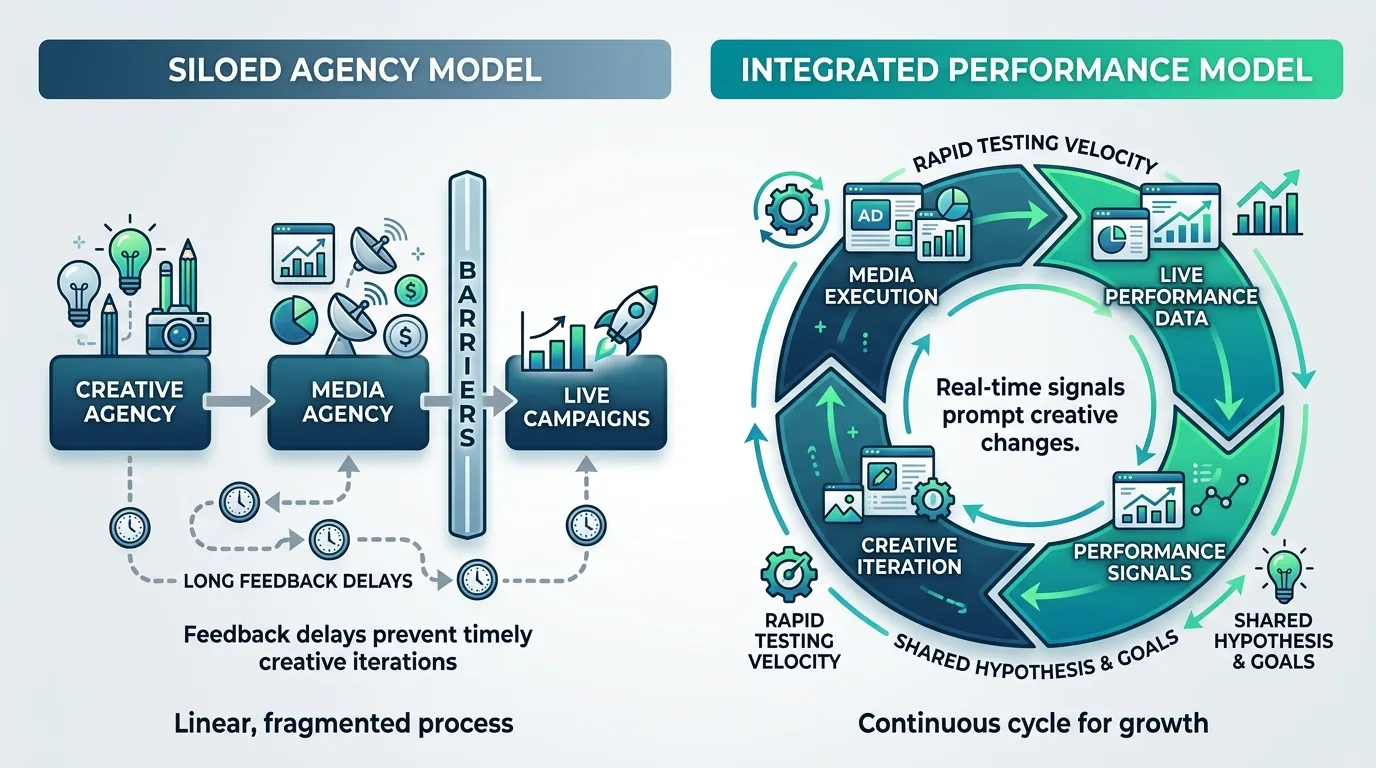
The operating cadence should be simple. Media performance identifies opportunities and breakdowns. Creative turns those findings into new hypotheses and variations. Campaigns launch quickly with clear naming and measurement. Results are reviewed at the angle, hook, format, audience, and placement level. Winners receive more spend. Losers are cut without debate. The next creative batch is informed by what actually happened.
This model requires volume, but volume without control is just noise. The goal is not to produce hundreds of random ads. It is to create enough purposeful variation to isolate what drives results. A team might test one offer across multiple hooks, then test the strongest hook in several formats, then adapt the winning message for different channels or audience segments.
Operational discipline is what makes that repeatable. Clear briefs, asset taxonomies, launch checklists, centralized reporting, and consistent campaign structures prevent high output from becoming account chaos. At Conversion Collective, that connection is the point: high-velocity creative and media buying are managed as a single system so performance signals can move directly into the next launch cycle.
How to Choose the Right Partner
Start with the bottleneck, not the agency category. If your company lacks positioning, needs a brand refresh, or is preparing a major product launch, a creative agency may be the best investment. If you have proven assets and need experienced operators to expand channel coverage, manage larger budgets, and improve buying efficiency, a media agency may solve the immediate problem.
If you are already spending heavily on paid acquisition and performance has stalled, look closer. Are ads being tested in enough volume? Does the creative team receive specific performance feedback within days instead of vague requests at month-end? Can your partner explain why an ad won, not just that it won? Can it launch fresh concepts across channels without requiring a new production cycle every time?
Those questions reveal whether you need separate specialists or an integrated performance partner. The answer depends on your internal capabilities, budget, brand maturity, and speed requirements. There is no advantage in paying for an integrated model if your paid program is small and your primary need is a one-time brand campaign. There is also little value in a beautifully separated agency roster if coordination is draining weeks from every learning cycle.
The partner worth choosing is the one that makes your next decision clearer: what to test, what to stop funding, and what deserves more budget now.