
Install volume is easy to buy. Profitable users are not. When a campaign starts delivering more downloads but trial starts, subscriptions, purchases, or retained users fail to follow, the problem is rarely a single setting inside an ad platform. It is usually a broken system between creative, targeting, campaign structure, and post-install measurement. A mobile app user acquisition agency should be built to manage that system as one operating function.
For growth teams, the question is not whether an agency can launch Meta, Google, or TikTok campaigns. Most can. The real question is whether the partner can produce enough creative, test it with discipline, read the right signals quickly, and shift spend toward the users your business can monetize.
What a mobile app user acquisition agency should own
App acquisition is often fragmented by default. A creative team develops ads on one timeline. A media buyer launches campaigns later. Analytics reports arrive after the budget has already moved. Each function can look busy while the account remains stuck.
A capable agency closes those gaps. Creative is produced against defined hypotheses, not generic requests for more assets. Media buyers launch tests in structures that preserve clean performance signals. Reporting connects platform data to downstream events such as registration, purchase, subscription renewal, or predicted lifetime value. That integration matters because an install is an input, not a business outcome.
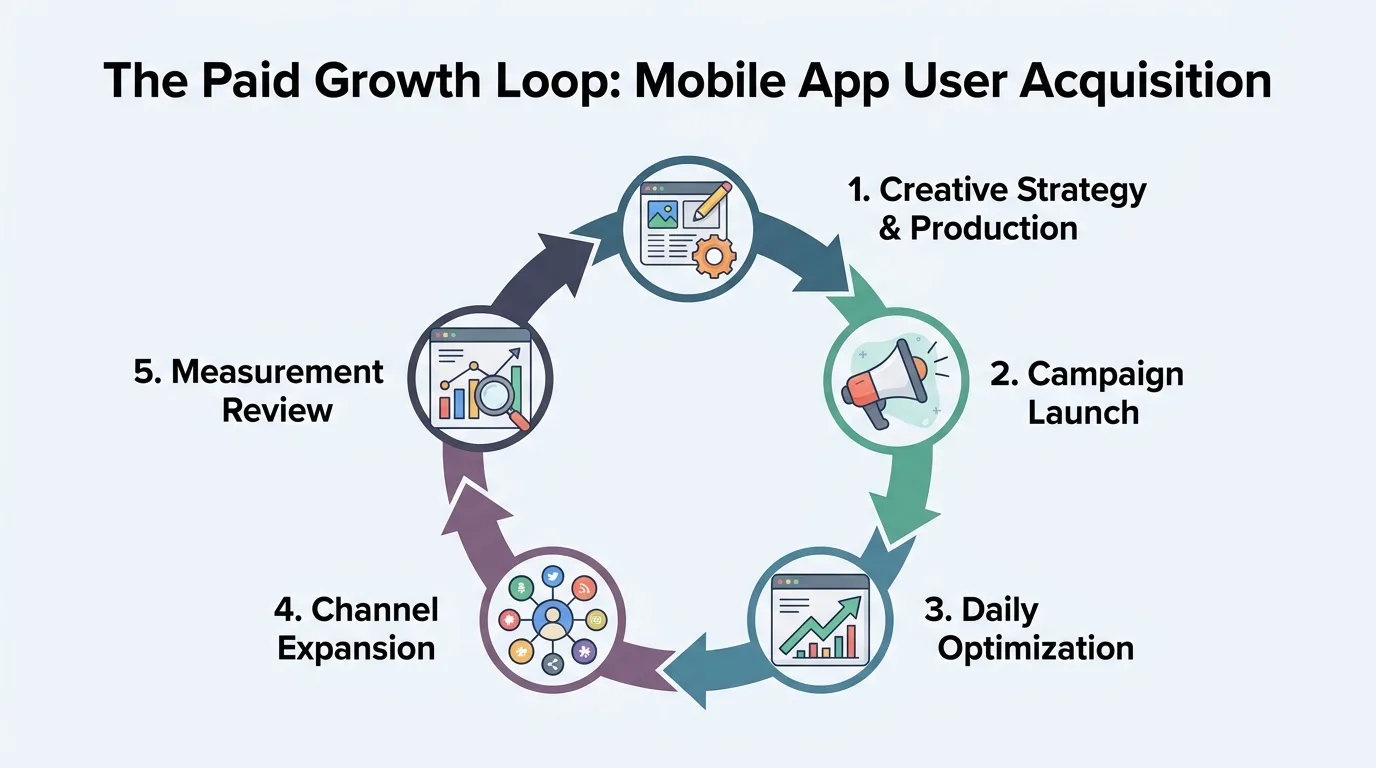
The work should cover the full paid growth loop: creative strategy and production, campaign launches, daily optimization, channel expansion, measurement review, and clear decisions about what to scale or cut. If creative production sits outside the media operation, testing slows down. If media buying is disconnected from retention data, the team can optimize toward cheap users who never become customers.
This does not mean every app needs every channel at once. A subscription app with clear purchase events may find strong early traction on Meta and Google App Campaigns. A utility app with broad appeal may benefit from TikTok’s creative range. A content product can test native placements where the economics support it. Channel selection should follow audience behavior, creative fit, attribution confidence, and marginal return, not a standard agency package.
The signal that you have outgrown your current setup
Most teams do not need outside help because they lack access to ad accounts. They need it when execution can no longer keep pace with opportunity.
The clearest signal is low testing velocity. If the team has identified a promising audience or offer but can only launch a handful of new concepts each month, spend will eventually outrun creative performance. Mobile audiences fatigue quickly. A winning hook can decline in days, particularly on short-form video placements. Without a steady pipeline of new angles, formats, openings, and proof points, the account becomes dependent on yesterday’s winner.
Another signal is inconsistent decision-making across channels. Meta may be optimized to cost per install, Google to first purchase, and TikTok to click-through rate. Each dashboard can look reasonable, yet the combined program has no shared definition of a quality user. A growth partner should establish the event hierarchy and economic thresholds that guide every platform.
The third signal is operational drag. Campaigns wait for naming conventions, creative approvals, tracking checks, and manual reporting. Small delays compound. By the time a team identifies a strong concept, the market has moved or the budget has been reallocated. High-performing acquisition programs create control through systems, not through more meetings.
How to evaluate an agency before giving it budget
The right partner will make its operating model easy to inspect. Ask how creative briefs become live tests, how quickly new assets are launched, and what triggers a decision to scale or pause spend. Vague answers about optimization or proprietary expertise are not enough. You need to understand the cadence.
Test creative volume without creating noise
More ads do not automatically produce better results. High-volume production only works when concepts are organized around useful variables: the opening hook, problem framing, audience motivation, offer, visual format, social proof, and call to action. If every asset changes six things at once, the team cannot tell why one won.
Ask to see how the agency separates concept testing from iteration. A concept may test whether users respond to saving time versus gaining control. Once a direction wins, iterations can test the first three seconds, creator style, demo sequence, or on-screen copy. This produces learning that compounds instead of a pile of disconnected ads.
Look for media buying discipline
Account structure should support decisions, not satisfy a preference for complexity. An agency should explain why it uses campaign consolidation, audience segmentation, geo splits, or budget controls for your specific app. The answer depends on spend level, event volume, privacy constraints, and the platform’s optimization model.
It should also be direct about trade-offs. Broad targeting can give the platform more room to find converters, but it can make audience insights less precise. Tight segmentation can provide useful control, but may restrict delivery and delay learning. A good operator knows when to simplify, when to isolate a test, and when the data is too thin to support a conclusion.
Verify that measurement reaches beyond installs
Attribution is imperfect, especially across iOS, Android, web-to-app flows, and subscription products with delayed payback. That is not a reason to optimize blindly. It is a reason to define a practical measurement framework before scaling.
The agency should understand your mobile measurement partner, event taxonomy, attribution windows, and the gap between platform-reported performance and business results. For an early-stage app, cost per registration or trial start may be the best usable proxy. For a mature subscription product, first payment, retained subscriber cohorts, or contribution margin may be more appropriate. The correct target depends on how quickly reliable downstream signals arrive.
Expect reporting that leads to action
A monthly deck full of charts is not operational reporting. You need answers to simple questions: What is working? What changed? What is being tested next? Where is budget being reduced? What must be true before spend increases?
That level of clarity protects the relationship on both sides. It prevents the agency from hiding behind blended results, and it prevents the client team from reacting to normal daily volatility. Conversion Collective approaches this through centralized campaign systems and a rapid testing cadence, so creative and media decisions are made from the same performance view.
Build the relationship around profitable growth
Agency compensation can shape behavior. A model tied only to percentage of spend creates an obvious tension: the agency earns more as budget rises, even when efficiency weakens. That does not make every spend-based arrangement ineffective, but it does make accountability more important.
Set the commercial model around the outcome that matters to your business. That may include an efficiency target, contribution margin, qualified subscriber volume, or a blended acquisition cost ceiling. The metric should be measurable, within a reasonable attribution window, and difficult to manipulate through shallow optimization.
The client also has responsibilities. A partner cannot fix weak onboarding, an unclear paywall, poor product-market fit, or a broken analytics implementation with better ads alone. The best engagements move quickly because product, creative, analytics, and acquisition stakeholders agree on the bottleneck and resolve it without turning every decision into a committee process.
A practical operating cadence for app growth
The strongest programs run on a repeatable rhythm. Each week starts with performance review and a decision about where marginal budget should go. Creative production follows a prioritized testing roadmap, with new concepts and iterations ready before fatigue becomes visible. Campaign launches are checked for tracking, naming, budget logic, and placement fit. Then performance is monitored against the event that best predicts value.
At scale, this process needs infrastructure. Thousands of ads, campaigns, and placements create avoidable chaos when launches and reporting depend on spreadsheets and manual handoffs. Centralized tooling gives teams a consistent way to deploy tests, compare creative performance, and identify winners without losing the detail required for optimization.
Do not judge the program solely by how quickly it spends. Judge it by the speed at which it turns spend into validated learning, then converts that learning into profitable scale. The agency worth keeping will make that cycle faster, clearer, and harder for competitors to match.