
Most teams do not need more ad inspiration. They need a repeatable way to find ads worth copying - then identify the specific performance mechanics worth testing in their own account. The distinction matters. Copying a competitor’s headline or video frame-for-frame produces lookalike creative with no strategic advantage. Studying the structure behind an ad that has earned distribution can produce a faster path to a real winner.
The goal is not to imitate another brand’s identity. It is to reduce guesswork. Strong competitor research gives your team better hypotheses, clearer test priorities, and a larger pool of proven market patterns to adapt. That is how creative research becomes part of a disciplined acquisition system rather than a folder full of screenshots.
What Makes an Ad Worth Studying?
An ad is not worth studying because it looks polished. It is worth studying because there is evidence that it is being funded, repeated, or adapted across placements. In performance marketing, longevity and volume are usually stronger signals than design taste.
Start by looking for ads that have been active for weeks or months, not just a few days. A long-running ad may indicate that it is meeting a profitable efficiency threshold, especially for direct-response brands that turn creative over quickly. Multiple variations built around the same opening, offer, or visual device are another useful signal. When a brand makes five versions of one angle, it is likely responding to performance data.
You should also pay attention to repetition across channels. A concept that appears in Meta feeds, TikTok-style video, native placements, and display formats may have a durable core message. The executions will differ, but the underlying customer tension may be strong enough to travel.
None of these signals prove an ad is profitable. Large brands can spend on awareness, run inefficient tests, or keep campaigns live for reasons you cannot see. Treat external research as evidence for a hypothesis, not proof of a winner.
Where to Find Ads Worth Copying - Strategically
The best research process is broad enough to reveal patterns and narrow enough to produce decisions. Do not only study your closest three competitors. Their creative often reflects the same assumptions your team already has.
Build a market set that includes direct competitors, adjacent categories, aggressive direct-response advertisers, and brands selling to a similar buyer with a different product. A subscription app can learn from a publisher’s quiz funnel. A lead generation business can learn from how an ecommerce brand handles objections. A supplement advertiser may find useful offer architecture in financial publishing.
Platform ad libraries are useful because they show active creative at scale. Search by advertiser, keyword, category, and offer language. Native ad feeds and publisher placements can expose angles that are less visible in social libraries. Search results pages, creator content, landing pages, email capture flows, and customer reviews add context that a single ad cannot provide.
The key is to record the ad with its surrounding conditions. An ad saying “Get your personalized plan” means little on its own. It means more when you can see that the click leads to a short quiz, a segmented recommendation, and a time-bound subscription offer.
Capture the mechanics, not just the asset
A useful swipe file is not an image dump. Every entry should answer a consistent set of questions:
- What audience problem or desire does the ad lead with?
- What is the first two seconds of the video or the first visual element?
- What proof is used: demonstration, testimonial, data point, editorial authority, or social proof?
- What offer, urgency device, or risk reversal moves the user toward action?
- What does the ad ask the user to do next?
- What landing page or funnel experience continues the message?
This turns research into structured inputs your creative and media teams can use. It also makes trends easier to spot. If 12 advertisers in a category use the same objection-led hook, that does not mean you should copy the line. It means the objection deserves to be tested.
Break Winning Ads Into Testable Variables
An ad is a bundle of decisions. If you copy the bundle, you cannot tell what caused the result. Break it into variables that can be tested independently.
For video, separate the hook, problem framing, presenter type, proof, pacing, visual format, offer, and call to action. For statics, separate the image concept, headline, subhead, proof element, price or incentive, and layout. Then identify which variable is most likely carrying the message.
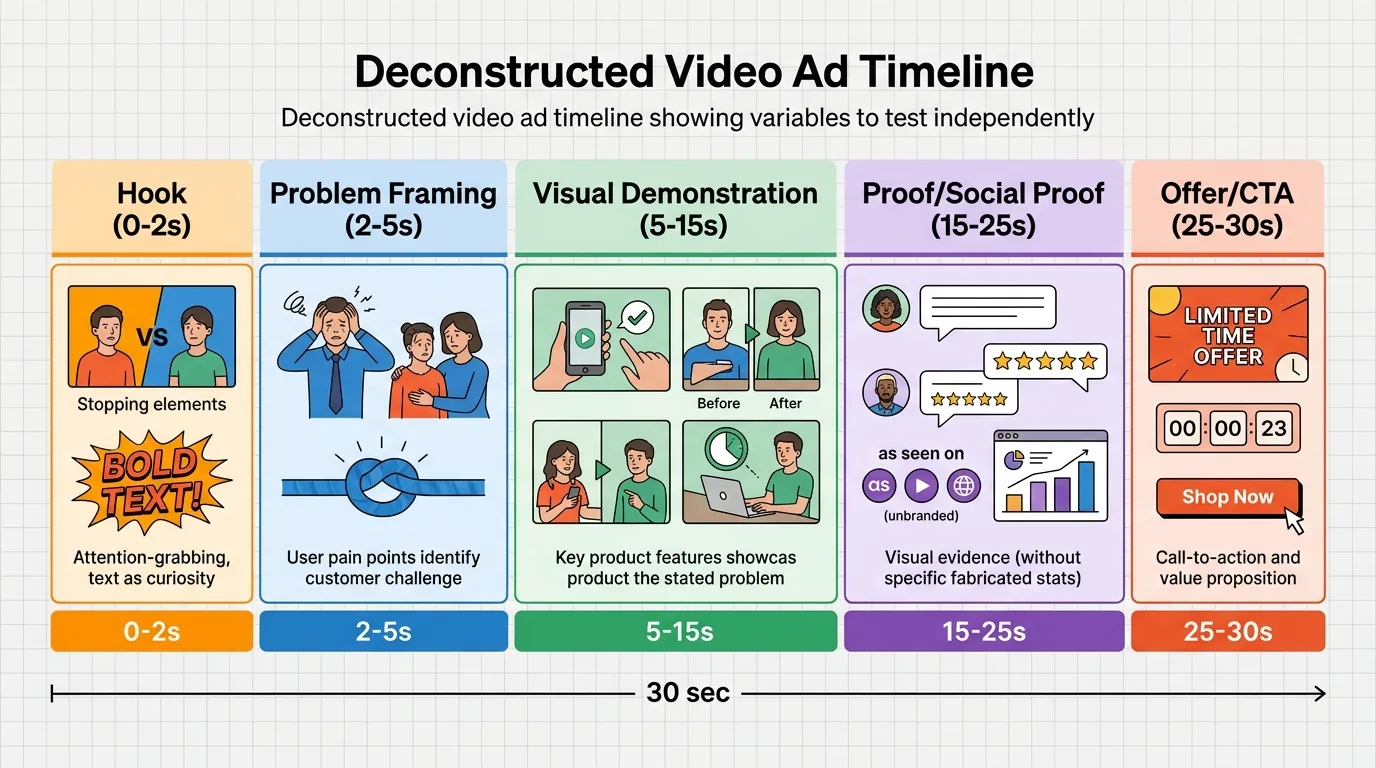
Consider a competitor video that opens with a frustrated customer, shows a product demonstration, cites a specific result, and ends with a limited-time offer. The useful insight may be the problem-first opening. Or it may be the tangible demonstration. Or the offer may be doing most of the work. Your first test should isolate one or two of those variables rather than recreating all of them at once.
This is where many teams waste budget. They see an ad with traction and build one nearly identical version. If it fails, they learn nothing. If it works, they still do not know whether the hook, visual, proof, or promotion drove the outcome.
A better approach is to create a test family. Keep the audience, campaign objective, and landing page stable where possible. Develop several executions around one market insight, each with a deliberate variation. That produces cleaner signals and gives winners a path to iteration.
Match the Pattern to Your Funnel
A competitor’s top-of-funnel ad can fail badly when dropped into a bottom-of-funnel campaign. The message must match the level of awareness, the buying cycle, and the friction in your own funnel.
Broad emotional hooks can work well when your product is easily understood and your conversion path is short. More complex offers often need education, credibility, or qualification before a direct call to action will convert efficiently. A high-ticket lead campaign may need to filter aggressively, while a low-cost ecommerce offer can prioritize click volume and post-click conversion rate.
Also consider the platform. A polished founder-led video may work in a social feed but underperform in a native environment where editorial framing earns more attention. A direct price card may succeed in retargeting but create low-quality traffic in prospecting. The market insight can remain consistent while the execution changes by channel and funnel stage.
Use Performance Data to Decide What Survives
Creative research sets the direction. Your account data makes the final call. Establish the metric that matters before launch: qualified lead rate, cost per purchase, trial-to-paid conversion, contribution margin, or another outcome tied to profitable growth.
Do not judge every ad only by cost per click. Low-cost clicks can hide weak intent, poor landing page fit, or low downstream conversion. At the same time, do not kill a creative solely because its first-day CPA is high if early indicators show better engagement quality and the campaign has not spent enough to produce a reliable read.
The right decision threshold depends on conversion volume, attribution lag, budget, and the cost of being wrong. Fast-moving accounts need fast decisions, but speed without controls is just churn. Set minimum spend or conversion thresholds, review results on a predictable cadence, and document why each concept was scaled, iterated, or cut.
When a concept wins, do not simply increase budget. Expand it intelligently. Test new hooks against the same core mechanism. Change the proof format. Create shorter and longer versions. Adapt it for different placements. Build fresh executions before frequency erodes response. Scaling creative means extending the life of the insight, not forcing one asset to carry the account.
Keep the Process Legal and Useful
There is a clear line between learning from the market and copying protected creative. Do not reuse another brand’s footage, logo, product images, testimonials, claims, scripts, or distinctive visual identity. Do not borrow claims you cannot substantiate. In regulated verticals, that last point can create material compliance risk.
The useful unit of research is the principle: an objection customers recognize, a proof format that lowers skepticism, a demonstration that makes value concrete, or an offer structure that reduces hesitation. Your brand should express that principle with original assets, accurate claims, and a message grounded in your own product.
The teams that scale efficiently do not wait for a perfect idea. They build a research loop, turn patterns into controlled creative tests, and let performance decide what earns more budget. The next useful ad is already in the market. Your advantage comes from seeing the mechanism quickly, testing it cleanly, and executing the next iteration before everyone else catches up.